
AI Product Q&A Chat: How to Increase Shopify Conversion Rate on Complex Catalogs

A shopper lands on your product page ready to buy. They have one question: will this fit, will it work with what they already own, is it right for their skin type. They scan the description, don't find the answer, and leave.
That single unanswered question is where an AI product Q&A chat earns its keep. It's why the Shopify conversion rate on complex catalogs lives or dies on how well you handle pre-purchase questions. More than half of US shoppers walk away when the information isn't there.
Specifically, 54% of shoppers have abandoned a purchase when product content was inconsistent or incomplete from one channel to the next. On a simple catalog you can paper over that with a longer description. On a complex one, you can't, because every shopper has a different question and no single description answers all of them.
This guide breaks down why complex catalogs bleed sales at the question stage, and how AI product Q&A chat lifts your Shopify conversion rate once it actually reads your product data.
Why Do Shoppers Bounce on Complex Shopify Catalogs Even When They're Interested?
They bounce because interest isn't the same as confidence, and complex products create a confidence gap that your page doesn't close. A shopper can love a jacket and still leave because they can't tell if the medium runs small. The desire was there. The certainty wasn't.
This is a bigger problem than most merchants realize. 73% of consumers say they struggle to find all the product information they need to make a confident purchase decision. When the answer isn't obvious, the safest choice for a shopper is to close the tab. No answer feels like a red flag.
The trigger is almost always a question that surfaces at the exact moment of decision. Not before, not during casual browsing, but right when a card is about to hit the cart. That's the same silent exit point we covered in our breakdown of how AI chat recovers sales lost to unanswered questions, and it compounds hard when your catalog demands more thinking per purchase.
There's a second layer here too. Inconsistent information is as damaging as missing information.
If your spec sheet says one thing and your description implies another, the shopper doesn't investigate. They leave.
And when they don't leave, 71% of shoppers have made a return because the product they received didn't match the online listing. Inconsistency doesn't just cost the sale. It comes back as a refund.
What Makes a Product Catalog "Complex" for AI Chat (and Why Generic Chatbots Fail It)?
A catalog is complex when the buying decision depends on matching product attributes to the shopper's specific situation, not just on price and looks. Complexity comes from variants, specs, compatibility, and fit, and it's exactly where generic chatbots fall apart.
Think about what "complex" actually means in practice. It's a high SKU count with dozens of variants per product. It's technical specifications that only matter to certain buyers.
It's compatibility rules where product A works with B but not C. It's fit and suitability, where the right answer changes per person.
A generic chatbot fails these because it doesn't know your catalog. It was trained on the open internet, so when a shopper asks whether your specific cable supports 240W charging, it either dodges the question or invents an answer. Neither converts.
Worse, a confident wrong answer is more dangerous than an honest "I don't know," because the shopper acts on it. This is the foundational problem behind every serious chat deployment, which is why our guide on automating Shopify customer support with AI stresses grounding over cleverness.
Variant complexity is its own beast on Shopify. The platform caps you at a limited number of options and combinations natively, which is why merchants pile on custom fields and third-party option apps. We documented the ceilings in detail in our look at Shopify product options limitations and how to fix them. The more workarounds you stack, the more places a chatbot has to look to answer correctly, and the more a generic one will miss.
How Do Unanswered Pre-Purchase Questions Actually Cost You Sales and Drive Up Returns?
Unanswered questions cost you twice: once at checkout when the shopper leaves, and again after checkout when a wrong guess turns into a return. Most merchants only count the first cost. The second one is often bigger.
Here's the causal chain nobody connects properly. A shopper has a question. Your page doesn't answer it, so they either abandon (lost sale) or guess and buy anyway (ticking time bomb).
When they guess wrong, the product comes back. 43% of consumers have returned a product in the past year because the pre-purchase information turned out to be incorrect.
On complex catalogs, the return reasons cluster exactly where the questions cluster. Sizing, fit, and color account for 45% of all retail returns, according to Capital One Shopping analysis. Those are pre-purchase questions that never got a confident answer. The return is just the delayed invoice for a question you didn't handle.
Now flip it. When product pages give shoppers a way to get answers, the numbers move sharply in your favor.
Bazaarvoice found that product pages with Q&A saw a 447% higher conversion rate compared to pages without it. That's not a rounding error, it's a different business. Answering the question isn't a support cost, it's a revenue mechanism, and it doubles as return prevention.
The same logic drives why product reviews lift Shopify conversion rates: shoppers trust concrete answers to their real concerns, whether those answers come from a stranger's review or a chat that read the product sheet.
What's the Difference Between a Scripted Chatbot, an FAQ Bot, and a RAG-Grounded AI Chat?
The difference is where the answer comes from. A scripted bot follows decision trees, an FAQ bot keyword-matches canned responses, and a RAG-grounded chat retrieves your actual product data before it generates a reply. Only the last one can handle a complex catalog.
Let me break down how each one behaves when a shopper asks a real question.
Scripted chatbot
This is a flowchart. It gives the shopper buttons ("Track my order", "Return policy") and follows a fixed path.
Ask it anything off-script, like "does the large fit a 42-inch chest," and it hits a dead end or hands off to a human. Fine for basic routing. Useless for pre-purchase catalog questions.
FAQ / keyword bot
This matches the shopper's words to a pre-written answer library. It works when a merchant has anticipated the exact question and written a canned reply. On a complex catalog with thousands of variant-specific questions, you cannot pre-write them all, so coverage collapses and the bot falls back to "I didn't understand that."
RAG-grounded AI chat
RAG stands for Retrieval-Augmented Generation. Instead of answering from generic training data, the chat first retrieves the relevant products, specs, and pages from your store, then generates a natural-language answer based on that retrieved content. This is what lets it answer a variant-specific question it has never seen before, because the answer is assembled from your live catalog, not memorized in advance.
The accuracy gap is measurable. Organizations report 70-80% fewer hallucinations after implementing RAG, grounding the model in retrieved source data instead of letting it answer from memory. That's the whole game on a complex catalog.
An app like RagChat is built on this mechanism specifically, answering shopper questions from your products, collections, and pages so replies are accurate rather than generic. It's the difference between a bot that reads your store and one that improvises.
How Does AI Product Q&A Chat Improve Shopify Conversion Rate on Complex Catalogs?
It converts by giving the shopper a confident, specific answer at the exact second doubt would have made them leave. The mechanism is retrieval first, generation second, so the reply is anchored to real product facts instead of a plausible-sounding guess.
Walk through a single conversion. A shopper viewing a pair of running shoes asks, "are these good for wide feet." A RAG-grounded chat retrieves that product's width options, material notes, and any relevant fit guidance, then answers: "This model comes in a 2E wide fitting, and reviewers with wide feet rate it well."
The shopper's last objection is gone. They buy. No human touched the conversation.
Scale that across a large catalog and the aggregate effect is real. AI-driven product discovery and guided selling increases conversion rates 15-35% versus static search and category navigation on large catalogs. When a shopper can ask instead of hunt, more of them finish.
Here's my hot take: most "AI chatbot" apps on the Shopify App Store are FAQ bots wearing a GPT wrapper. A chatbot that confidently guesses wrong on "will this fit me" or "is this compatible with X" is worse than having no chatbot at all, because it hands your most complex-catalog customers a persuasive reason to buy the wrong thing and return it. The real conversion lever isn't "having AI chat." It's whether that chat reads your product data before it answers.
That's why the retrieval step matters more than the model. A smarter language model with no access to your catalog will still hallucinate a spec. A modest model grounded in your real products will quote it correctly. For a complex catalog, grounding beats brilliance every time.
Which Shopify Verticals See the Biggest Conversion Lift from AI Product Q&A (Apparel, Electronics, Beauty, Specialty)?
The biggest lift lands in verticals where the buying decision hinges on matching a product to the shopper's body, gear, or use case. Apparel, electronics, beauty, and specialty retail all share that trait, and each one has a distinct question type that a RAG-grounded chat is built to answer. The common thread is that a generic description can never anticipate every shopper's specific situation, so the answer has to be generated on demand from the actual product record.
Apparel and footwear (sizing and fit)
The questions here are personal and comparative, not generic. Shoppers reason relative to brands they already own, and no static size chart accounts for that.
- "I'm normally a medium in brand X, what size here?"
- "Does this run long, or true to size?"
- "Will this fit a 34-inch inseam?"
Given that fit, sizing, and color drive nearly half of all retail returns, this vertical sees both a conversion lift and a return reduction from accurate chat. A chat that can compare your sizing to a shopper's known reference brand closes the loop a chart never could.
Electronics and tech (specs and compatibility)
These are yes-or-no factual questions with expensive consequences attached to a wrong guess.
- "Does this monitor support 144Hz over USB-C?"
- "Is this charger compatible with a MacBook Pro 16?"
- "What's the actual port layout on the back panel?"
A shopper who guesses wrong on any of these returns a bulky, high-value item, and shipping that back eats the margin twice. Compatibility is exactly the kind of query a scripted bot can't script and a RAG chat can retrieve straight from the spec sheet.
Beauty and personal care (skin type, hair type, suitability)
The questions here are about the shopper, not the product, which is exactly what makes them hard to answer with static content.
- "Is this good for oily, acne-prone skin?"
- "Will this work on color-treated hair?"
- "Is it fragrance-free and safe during pregnancy?"
The right answer changes per person, so it can't be baked into one description that tries to cover everyone. Grounded chat can cross-reference ingredients and product notes to answer suitability confidently, instead of hedging with "consult a dermatologist" on every question.
Specialty and niche retail (technical fit)
Bike parts, auto accessories, musical gear, hobbyist supplies: these categories run on technical fitment, where being close isn't good enough.
- "Does this fit a 2019 model?"
- "What thread size is this part?"
- "Compatible with a 12-speed drivetrain?"
These stores often carry huge SKU counts with dense variant data, which is exactly where native Shopify constraints bite hardest. If you're already wrangling that complexity, our comparison of the best Shopify product option apps for 2026 pairs well with a chat layer on top of it.
How Do You Know If Your Store Needs an AI Product Q&A Chatbot?
You need one when your catalog generates repeat pre-purchase questions that your product pages can't fully answer. If shoppers regularly ask the same fit, spec, or suitability questions before buying, that demand is already there, unmet. Here's a quick self-diagnostic.
- SKU and variant count. If you're past a few hundred SKUs or carry products with many variant combinations, static content can't cover every question. This is your strongest signal.
- Support ticket themes. Pull your last month of pre-sale messages. If "will this fit / work with / suit me" questions dominate, those are conversions you're handling manually and slowly, or losing overnight.
- Return reason codes. If sizing, fit, compatibility, or "not as described" lead your returns, you have a pre-purchase information problem, not a product problem.
- High-consideration price points. Expensive or technical products get more questions and more hesitation. Higher stakes mean more shoppers need reassurance before they commit.
- Traffic without conversion on product pages. Strong sessions and weak add-to-cart on complex products often means shoppers arrive interested and leave uncertain.
Picture a mid-sized outdoor gear store: 800 SKUs, a return rate creeping past 20%, and a support inbox full of "will this jacket actually hold up in real rain or just drizzle." That's not a hypothetical. It's the exact profile where AI product Q&A chat pays for itself inside the first month.
Tick two or more of these and the math favors a chat layer. A solo operator especially benefits, since the alternative is answering the same questions by hand at all hours. We covered that survival mode in automating Shopify support without a team, and complex catalogs make the case even stronger.
How Do You Prepare Your Shopify Catalog Data for an Accurate AI Chat Rollout?
You prepare it by making your product data complete, structured, and consistent, because a RAG-grounded chat is only as accurate as the catalog it retrieves from. Garbage in, confident-sounding garbage out. This is the step almost every merchant skips, and it's the one that determines whether your chat converts or embarrasses you.
Think of it this way: the chat doesn't invent answers, it retrieves them. If the width option isn't recorded on the variant, the chat can't tell a shopper the shoe comes in wide.
If two fields contradict each other, the chat may surface the wrong one. Data readiness is the prerequisite, not the follow-up.
Here's the practical prep checklist before you flip the switch.
- Complete every description. Thin or blank descriptions leave the chat with nothing to retrieve. Fill the gaps, and write them for humans and machines both. Our guide on writing Shopify product descriptions that rank and convert doubles as chat-training material.
- Structure your specs. Put technical attributes into consistent fields (dimensions, materials, compatibility, care) rather than burying them in prose. Structured data retrieves cleanly.
- Fix variant accuracy. Make sure every size, color, and option is correctly recorded and mapped. Wrong variant data produces wrong fit answers, which produce returns.
- Kill contradictions. Reconcile spec sheets, descriptions, and titles so they agree. 54% of shoppers abandon a purchase over inconsistent content, and your chat will faithfully repeat whichever version it retrieves.
- Audit at scale. Cleaning hundreds of products by hand is brutal. A bulk editor makes it feasible, and we compared the options in our roundup of the best Shopify bulk product editor apps for 2026.
While you're in there, treat this as an SEO win too. The same complete, structured product data that feeds accurate chat also strengthens your organic pages, which our Shopify product page SEO checklist walks through in full. One cleanup, two payoffs.
What's the Fastest Way to Add Grounded AI Q&A to a Complex Shopify Store?
The fastest path is to install a RAG-grounded chat app that learns from your existing catalog, then validate its answers against your hardest questions before you trust it live. You don't need to rebuild anything. You need the chat to read what you already have.
Start with the app that matches the mechanism this whole article argues for. RagChat: AI Chatbot & Livechat answers customer questions from your real products, collections, and pages using RAG, so replies stay accurate instead of generic. Its free plan includes unlimited AI replies and learns up to 200 products, which is enough to test grounded chat on a real catalog before spending a cent. Paid tiers scale to 1,000 and 5,000 products for larger stores.
Budget for this the way you'd budget for a return-reduction project, not a nice-to-have extra. A free grounded chat that prevents even a handful of wrong-fit returns a month has already paid for the time it took to install it.
Don't skip validation just because the app is live in minutes. A grounded chat is only as trustworthy as the answers you've checked yourself, and the first week is when small data gaps surface. Before going live, do this validation pass:
- Feed it your top 20 pre-sale questions. Pull them from support tickets and test the chat's answers against what you know is true.
- Test the tricky variants. Ask the compatibility and fit questions that trip up generic bots. Accuracy here is the whole point.
- Confirm the "I don't know" behavior. A good grounded chat should defer or hand off when it lacks data, not fabricate. Verify it fails safely.
- Watch the handoff to humans. Make sure genuine edge cases route to you or your team cleanly, so nothing high-value slips.
Then keep it fed. Every time you add products or spot a question the chat fumbled, tighten the underlying data. A grounded chat improves as your catalog improves, which is why the data prep from the previous section pays compounding returns. Get the data right, ground the chat in it, and you turn your most common pre-purchase questions from silent exits into conversions.

RagChat: AI Chatbot & Livechat
SponsoredAI chat that answers from your real products. Unlimited AI replies on the free plan.
Related Articles
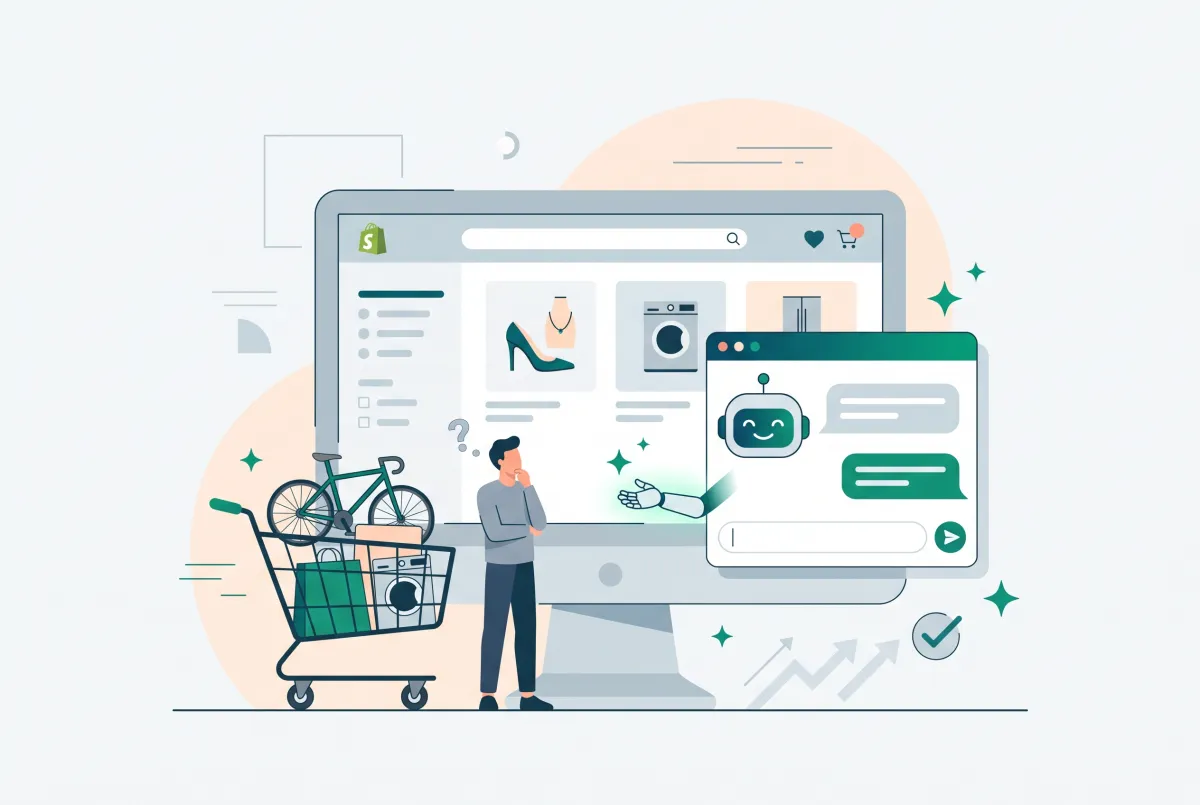
AI Chat for High-Ticket Shopify Stores: How to Answer the Questions That Stall a $2,000 Sale
High-ticket buyers stall on questions no FAQ page answers. Learn how AI chat for high-ticket Shopify stores handles objections and closes $2,000 sales.
Sizing, fit, and spec questions no one answered drive most returns. Learn how to reduce Shopify product returns with AI chat before an order ever ships.
Most Shopify cart abandonment isn't price shock, it's an unanswered question. See how real-time AI chat answers objections before shoppers leave.
AI Chatbot for Shopify: How to Automate Customer Support and Increase Sales
Learn how an AI chatbot for Shopify automates customer support, recovers abandoned carts, and boosts sales with 24/7 replies and smart product upsells.

What Your Shopify Chatbot Logs Reveal About Product Demand (And How to Use That Data)
Your Shopify chatbot logs are a market research goldmine. Learn how to read chat transcripts for real product demand signals and smarter roadmap calls.

How Product Reviews Increase Shopify Conversion Rates (And How to Get More of Them)
Product reviews can lift Shopify conversion rates by up to 380%. Learn how reviews, photos, and UGC turn browsers into buyers, with data to back it up.