
AI Chat for Global Shopify Brands: Covering Every Time Zone Without a 24/7 Support Team
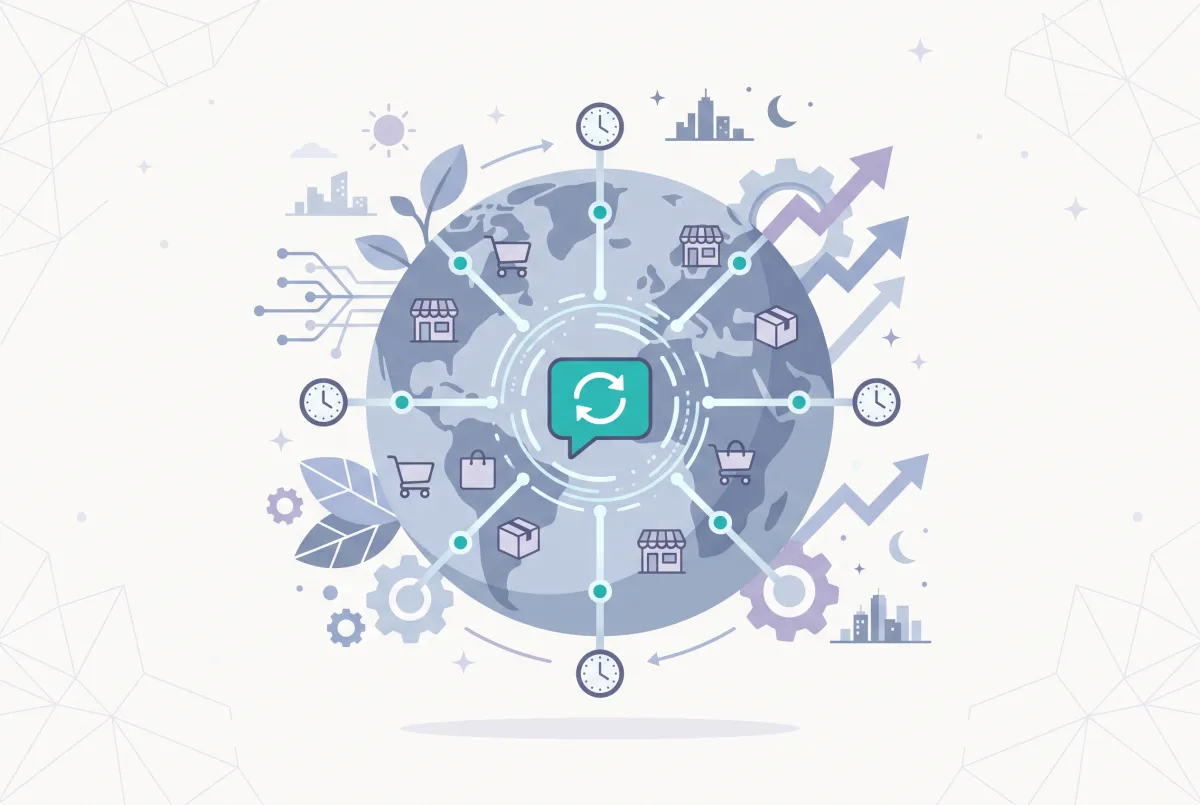
What happens to sales when your Shopify store goes quiet outside business hours?
Sales don't stop. Your team does. When a shopper in London lands on your product page at 9pm their time and your US support desk closed hours ago, that question about sizing or shipping just hangs there unanswered.
This is the case for AI chat for international Shopify stores, and it's less about customer service and more about revenue you're already losing. The customer doesn't file a complaint. They close the tab and buy from a competitor who answered.
That's the quiet cost. It isn't a loud angry ticket in the morning. It's an abandoned cart with no note attached, a pre-sale question that died at 2am, a returning customer who couldn't confirm their order shipped and assumed the worst. You never see the lost sale, so it never gets fixed. We've written before about how AI chat recovers sales lost to unanswered questions, and time zones make that leak worse for every market you add.
Speed matters more than most merchants think. Every 30-second delay in a pre-sales chat reduces conversion probability by 7%, and a visitor who waits two minutes is 28% less likely to buy than one who gets an instant reply, according to Helpable's response-time benchmarks. Overnight, your response time isn't two minutes. It's ten hours.
Why does selling internationally multiply the time zone coverage problem?
Because your customers are awake when your team is asleep, and there's almost no overlap. A US brand on Eastern time selling to the UK, Europe, and Australia isn't dealing with one after-hours window. It's dealing with three, and they barely touch your business hours at all.
Run the actual math. Say your support team works 9am to 5pm Eastern.
- UK shoppers (5 hours ahead): their day starts at 4am your time and their evening peak, around 8pm London, is 3pm for you. You share maybe a 3 to 4 hour window in your morning.
- Central Europe (6 hours ahead): even tighter overlap, mostly your early morning.
- Australia (14 to 16 hours ahead): near zero. When Sydney shops at 8pm, it's the middle of the night for you. Your entire Australian market browses, questions, and abandons while your desk is dark.
This isn't a niche problem anymore. Cross-border commerce keeps growing, with the cross-border e-commerce market valued at $1.21 trillion in 2025, and 59% of global shoppers now buy from retailers outside their home country. If you're a growing DTC brand, a chunk of your traffic is already international whether you planned for it or not.
And expectations have caught up. According to the Zendesk CX Trends report, 74% of consumers now expect customer service to be available 24/7. Your Australian customer doesn't care that it's 3am in New York. They expect an answer.
What does it actually cost to staff support across time zones with humans?
More than most founders guess, and the hidden costs are where it hurts. A single fully-loaded North American support seat runs about $72,700 a year, per Decagon's cost breakdown. Staff a small team around the clock and the baseline salary cost alone lands near $275,000 annually, before you add multilingual coverage, benefits, or turnover.
Overnight staffing is its own headache. Night teams see 30 to 45% annual turnover because working against your body clock burns people out fast, and that churn adds $30,000 to $80,000 in hidden replacement costs on a 10-person night team. Every departure means rehiring, retraining, and a gap in coverage while you scramble.
Even the individual wage isn't cheap. Night shift customer service agents average around $18 an hour in the US, with the typical range running $14.90 to $19.95 according to ZipRecruiter salary data. Multiply that by the shifts and languages you need, and a "scrappy" overnight desk stops looking scrappy.
Here's my hot take. "Follow the sun" staffing is consultant-speak for hiring three time zones of humans to solve a problem AI already solved. If you're a $2 to 10M brand paying a contractor in Manila or Bucharest to cover your overnight shift just so a UK customer can ask whether something runs true to size, you're not being scrappy. You're overpaying to badly replicate what an AI chatbot trained on your catalog does instantly, consistently, and without a 3am hiring headache.
How does AI chat close the time zone gap without a night shift?
AI chat answers instantly, in every time zone, at the same cost whether it's noon or 4am. It doesn't sleep, take breaks, or quit after six months of graveyard shifts. That's the whole point.
A well-configured AI chatbot trained on your product catalog, policies, and past tickets can handle the bulk of what comes in overnight without a human touching it. It answers the sizing question, checks the order status, explains the return window, and does it in seconds. Our full guide on how to automate customer support with an AI chatbot walks through the setup, but the time zone benefit is the part merchants underestimate.
The math flips completely. Instead of $275,000 for round-the-clock humans, most Shopify AI chat apps cost a flat monthly fee that doesn't change based on volume or hour. You're not paying per shift. You're paying once, and it covers Sydney at 3am and London at 5am and everyone in between.
This is where an app like RagChat: AI Chatbot & Livechat fits the problem cleanly. It's built to answer shopper questions from your actual product, collection, and page content, and it keeps running when your team is offline, with a shared human-and-AI inbox so anything the bot can't handle waits for morning without the customer going cold. Its free plan learns up to 200 products and gives unlimited AI replies, so you can test overnight coverage before spending a cent.
Can AI chat handle multiple languages and currencies for global customers?
Yes, and this is the part that compounds. Your overnight problem isn't just that the customer is awake at 2am. It's that they're awake at 2am and they speak a different language, and both problems land at once.
Language preference is stronger than most English-first merchants assume. A CSA Research study of 8,709 consumers found 76% prefer to buy products with information in their native language, and 40% will never buy from a website in another language at all. A German shopper who can't get a straight answer in German at 11pm doesn't wait for your English-speaking team to wake up. They leave.
Modern AI chat handles this without you writing a single translated help doc. The chatbot detects the shopper's language and replies in it, pulling from the product content you already wrote once. RagChat lists multi-language support among its features, so the same knowledge base can serve a French, Japanese, and Spanish customer at the same instant.
On the currency side, this pairs naturally with Shopify Markets, which handles local pricing and checkout while the AI handles the conversation. If you're still weighing platform-level international features, our honest Shopify vs BigCommerce comparison covers how each handles multi-currency selling.
What should multi-market Shopify brands automate vs. keep human?
Automate the repetitive, factual, high-volume questions. Keep humans for judgment calls, angry escalations, and anything involving money or exceptions. The line is clearer than it feels.
These are the questions AI should own overnight, especially for international orders where they spike:
- Order status and tracking, including "where is my package" for international shipments with longer transit windows.
- Shipping timelines, setting realistic expectations that a cross-border order takes longer than a domestic one.
- Customs and duties questions, explaining who pays and roughly what to expect at the border.
- Return and exchange policy, especially the "can I return this from another country" question.
- Product details, sizing, materials, compatibility, the true-to-size question that kills so many carts.
Keep a human in the loop for refund disputes, damaged-in-transit claims, custom order changes, and any conversation where the customer is clearly upset. A shared inbox means the AI handles the first response instantly and flags the rest for your team in the morning. The customer isn't ignored. They're acknowledged, and the hard stuff waits for someone who can actually decide.
If you're a solo operator rather than a scaling brand, the balance shifts even further toward automation. We cover that specific setup in how solo founders use AI chat to handle support without hiring.
How do you roll out AI chat coverage across time zones without disrupting current support?
Start with off-hours only, then expand. Turn the AI on for the windows your team doesn't cover, keep humans in charge during business hours, and widen the AI's scope as you trust it. Nobody has to rip out their existing setup on day one.
Here's a rollout order that keeps risk low.
- Feed the AI your data. Point it at your product catalog, shipping and return policies, and FAQ. The better the source content, the fewer bad answers. Our 2026 checklist for setting up live chat and AI support covers this step in detail.
- Go live overnight first. Let the AI handle your genuine after-hours windows, the ones where you currently answer nobody. Any answer beats silence, and the stakes are lowest here.
- Review the transcripts each morning. Read what shoppers asked and how the AI answered. Fix gaps by adding content, not by turning the bot off.
- Set the human handoff rules. Decide which topics escalate to your inbox and which the AI fully owns.
- Expand to peak hours. Once overnight is solid, let the AI take first response during the day too, freeing your team for the hard tickets.
The infrastructure question matters as you grow into more markets. More time zones means more concurrent traffic, and your store needs to hold up under it. If international expansion is part of your plan, it's worth reading how to build a Shopify store that handles 10x more traffic so your storefront and your support both scale together.
The global opportunity is real and it's already at your door. The overall e-commerce market is on pace to hit $6.88 trillion by the end of 2026, and for many Shopify stores 30% of visitors already come from international markets. You don't need to hire three time zones of humans to serve them. You need one AI that never sleeps and answers in their language, and you can have it running by this afternoon.

RagChat: AI Chatbot & Livechat
SponsoredAI chat that answers from your real products. Unlimited AI replies on the free plan.
Related Articles

Multilingual Shopify Customer Support: How AI Chat Serves International Customers Without Hiring Translators
Shopify Markets translates your storefront, not your chat. Here's how AI chat delivers multilingual Shopify customer support without hiring translators.
AI Chatbot for Shopify: How to Automate Customer Support and Increase Sales
Learn how an AI chatbot for Shopify automates customer support, recovers abandoned carts, and boosts sales with 24/7 replies and smart product upsells.

How AI Chat Handles BFCM Traffic Spikes for Shopify Stores Without Hiring Seasonal Staff
BFCM traffic can spike 5-10x overnight. See how AI chat handles Shopify Black Friday and Cyber Monday support without adding any seasonal support staff.

AI chat support for solo Shopify founders handles repetitive questions 24/7, so you can skip hiring, dodge burnout, and keep sounding like yourself daily.

How to Set Up Live Chat and AI Customer Support for a New Shopify Store (2026 Checklist)
Learn how to set up live chat and AI customer support for a new Shopify store, step by step, with the best AI app to automate support around the clock.
WISMO tickets can eat up to 50% of a growing Shopify store's support inbox. See how AI chat connected to real order data auto-answers them 24/7, for free.