
AI Agents for Shopify: How OpenClaw and Smart Automation Can Help You Sell More
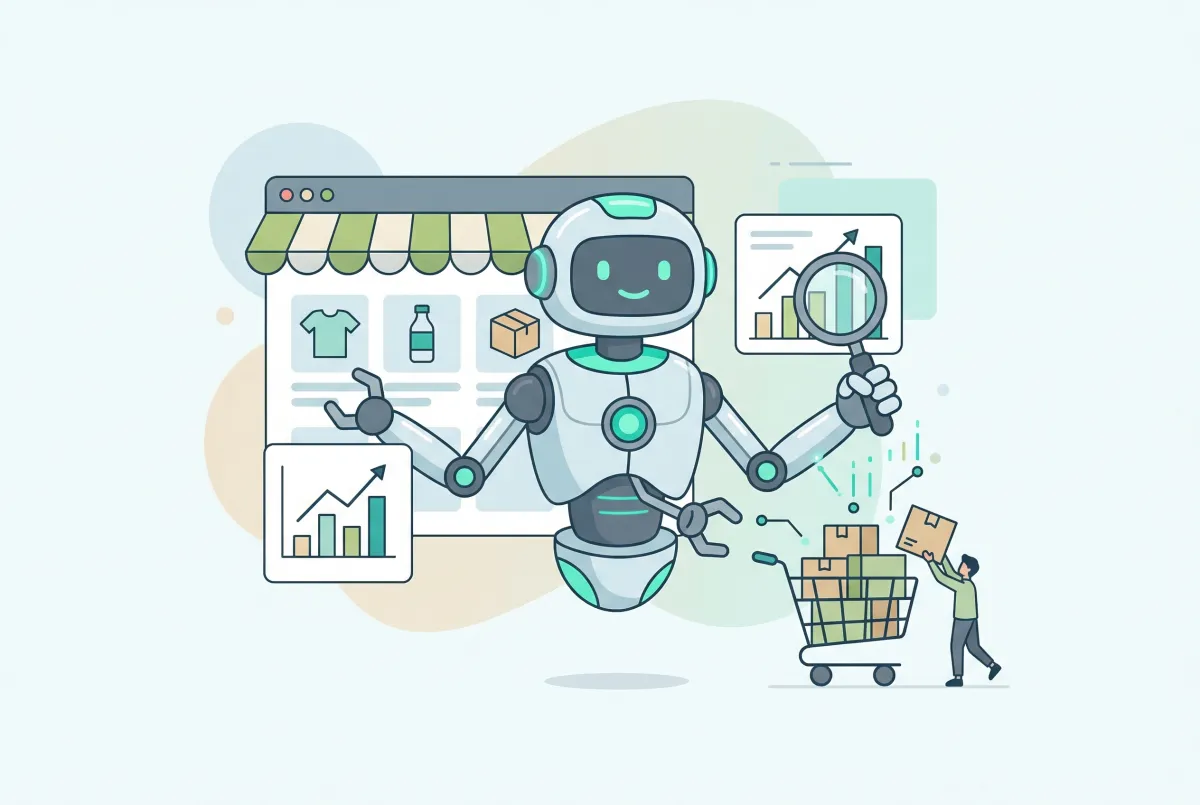
AI agents for Shopify stores aren't some far-off concept anymore. They're here, they're getting smarter fast, and they're already changing how merchants handle everything from inventory to customer support. But the gap between hype and reality is enormous. Most of the advice floating around tells you to "just automate everything," without explaining what AI agents actually do, which ones work for smaller stores, or where the real risks hide.
This guide breaks down what Shopify merchants should actually care about when it comes to AI agents in 2026, with specific tools, honest limitations, and a clear starting point for stores of every size.
What Exactly Is an AI Agent, and How Is It Different from a Regular Chatbot or AI Tool?
An AI agent is software that can take actions on your behalf, not just answer questions. While a chatbot waits for your input and responds with pre-scripted or AI-generated text, an agent watches your store, makes decisions based on rules you set, and executes tasks without you lifting a finger.
Think of it this way. A chatbot is like a cashier who answers questions at the register. An AI agent is more like a store manager who notices you're running low on a best-seller, reorders it, updates your product listing, and sends you a summary before you close your laptop. The agent doesn't just talk. It does things.
Regular AI tools (like ChatGPT or Shopify Magic) are incredibly useful for generating product descriptions, writing emails, or brainstorming ad copy. But they stop there. You prompt them, they respond, and you still have to copy, paste, and execute.
AI agents close that loop. They connect to your store's data, monitor changes in real time, and trigger actions based on conditions you define. This distinction matters because a lot of merchants are buying chatbot tools thinking they're getting agents. If the tool can't take an action inside your store without you clicking a button, it's an AI assistant, not an agent.
What Can AI Agents Actually Do for a Shopify Store Right Now?
AI agents can handle inventory monitoring, customer support triage, product catalog updates, reporting, and even some sales tasks today. According to recent data from EComposer, 77% of ecommerce professionals now use AI daily in 2025 (up from 69% in 2024), and 84% of ecommerce businesses are either integrating AI or planning to.
Here's what's actually working for Shopify merchants right now:
- Inventory management: Agents track SKU levels across sales channels and trigger reorder alerts (or automatic purchase orders) before stockouts happen. Research from Envive shows AI-driven demand forecasting cuts forecast errors by 30 to 50%, and organizations using it see stockout-related lost sales drop by up to 65%.
- Customer support: AI agents resolve common support tickets (order status, return requests, shipping questions) by pulling live order data. Some platforms report handling around 70% of tickets without human intervention.
- Product catalog updates: Agents rewrite product descriptions in your brand voice, optimize them for SEO, and push changes across your entire catalog. If you're already doing bulk product editing manually, this is where agents save the most time.
- Reporting and analytics: Daily briefings that pull data from Shopify, Google Analytics, and your ad platforms, then deliver a summary to Slack or email. No more logging into five dashboards every morning.
- Abandoned cart recovery: Agents engage visitors across chat, email, and even WhatsApp with personalized messages based on what's in the cart and the shopper's browsing history.
The conversion numbers back this up. Data from HelloRep shows shoppers who engage with AI-powered chat convert at 12.3%, compared to 3.1% for those who don't. That's a 4x lift, and those same shoppers complete purchases 47% faster when assisted by AI.
What Is OpenClaw, and How Does It Work for Ecommerce Merchants?
OpenClaw is an AI agent platform for ecommerce that lets merchants deploy autonomous agents for their store operations. It uses the Model Context Protocol (MCP) to connect with Shopify and other platforms, which means agents can pull real-time data from your store, your analytics tools, your ad platforms, and your support channels simultaneously.
For Shopify merchants specifically, OpenClaw handles inventory syncing across channels, automated order processing with fraud detection, product description generation, and multi-step workflows that tools like Zapier struggle with.
The safety features deserve attention here. OpenClaw encrypts all API credentials with AES-256-GCM and includes human-in-the-loop approval gates. You set dollar thresholds for what the agent can do autonomously versus what needs your sign-off. Routine tasks run on their own, while high-value decisions pause and wait for you.
The catch? OpenClaw requires more technical setup than a plug-and-play Shopify app. For stores doing under $50k per year, the setup cost probably isn't worth it yet. But for merchants in the $100k to $500k range who are drowning in repetitive tasks, the flexibility and control it offers can justify the investment.
Which AI Agents and AI Tools Should Shopify Merchants Be Using in 2026?
The right tool depends entirely on your store's revenue, team size, and which tasks eat the most time. There's no single "best AI agent" for every merchant. But there are clear tiers based on where you are.
For stores under $50k/year, start with Shopify's built-in tools. Shopify Magic handles product descriptions and email subject lines. Shopify's Winter '26 Edition introduced over 150 AI-powered features, including an upgraded Sidekick that builds Shopify Flow automations from plain-language instructions. Tell Sidekick "tag customers as VIP when they place an order over $200" and it builds the entire workflow in seconds.
For stores in the $50k to $200k range, add specialized apps that handle specific pain points. If you're importing products from other platforms, a tool like Migratify uses AI to simplify product migration from over 100 platforms. For managing product reviews at scale, apps with automated import and monitoring features save hours per week. And for catalog management, Edify lets you edit products, prices, and collections in bulk with preview, scheduling, and one-click undo.
For stores above $200k/year, that's where platforms like OpenClaw and enterprise-grade agent frameworks start making sense. The key is picking tools that integrate with each other, not stacking disconnected point solutions.
One thing worth emphasizing: 69% of retailers who implemented AI report direct revenue increases, and 72% report cost reductions. The ROI is real, but only if you pick tools that match your actual bottlenecks.
How Do You Know If Your Store Is Ready for AI Agents?
Your store is ready when you can clearly identify at least three tasks you repeat daily that follow a predictable pattern. If you can't name those tasks, you're not ready. You're just shopping for shiny tools.
Here's the honest truth, and this is my strong opinion on this: most Shopify merchants don't need an AI agent yet. What they need is to stop checking their dashboards manually twelve times a day.
The reason AI agents fail for small stores isn't the technology. It's that the merchant has never defined what "normal" looks like for their metrics. An AI agent that alerts you when sales drop 20% is completely useless if you've never decided what your baseline actually is. The real work before deploying any AI agent isn't setup. It's deciding which decisions you want to stop making yourself.
Before you spend a dollar on AI agents, answer these questions:
- Do you have documented processes? If your order fulfillment workflow lives entirely in your head, no agent can automate it. Write it down first.
- Do you know your key metrics and their normal ranges? Average order value, conversion rate, return rate, customer acquisition cost. If you don't know what "normal" looks like, you can't tell an agent what "abnormal" means.
- Are you spending more than 5 hours per week on a single repetitive task? That's your first automation candidate. Start there, not with a full AI overhaul.
- Do you have clean data? AI agents are only as good as the data they read. If your product tags are a mess, your inventory counts are off, or your customer segments don't exist, fix that first.
Stores in the $10k to $50k range should focus on Shopify Flow and built-in AI features before looking at third-party agents. Stores above $100k with at least one person handling operations can get real value from dedicated AI agent platforms. OpenClaw's sweet spot is merchants who have clear, repeatable processes but not enough staff to execute them consistently.
What Are the Risks and Limitations of Handing Tasks to an AI Agent?
The biggest risk isn't that the AI makes a mistake. It's that you don't notice when it does. AI agents can confidently execute the wrong action, and if you're not reviewing outputs regularly, small errors compound into expensive problems.
Here are the failure modes nobody talks about:
- Data drift: Your agent was set up when your average order value was $45. Six months later, it's $75 because you added a premium line. The agent's thresholds and rules are now wrong, but it's still running on old assumptions. You need to audit agent settings quarterly at minimum.
- Over-automation: Automating customer support sounds great until a VIP customer gets a generic AI response about a delayed custom order. Some interactions need a human, and drawing that line requires judgment that agents don't have yet.
- Vendor lock-in: Some AI agent platforms own your workflow data. If you cancel, your automations disappear. This is one reason open-source options are worth considering, even if setup is harder.
- Security exposure: Every agent that connects to your store needs API access. That's another attack surface. Verify that any tool you use encrypts credentials, supports permission scoping (read-only vs. write access), and provides audit logs of every action taken.
- Hallucination in customer-facing contexts: AI agents that interact with shoppers can occasionally generate incorrect information about products, shipping times, or return policies. Always set guardrails that prevent agents from making promises your store can't keep.
The practical safeguard is simple: start every agent in "shadow mode." Let it run alongside your manual process for two weeks. Compare its decisions to yours. Only hand over control once you've verified it matches your judgment at least 95% of the time.
What Will AI Agents Look Like for Shopify Merchants in the Next 12 Months?
The next year will be defined by agents that talk to each other, not just to your store. Right now, most AI tools operate in silos. Your support agent doesn't know what your inventory agent is doing. By early 2027, expect agent orchestration to become standard in enterprise ecommerce platforms.
The numbers suggest massive acceleration. The global AI agents market was valued at $7.63 billion in 2025 and is projected to reach $182.97 billion by 2033, growing at a 49.6% CAGR. 97% of retailers plan to increase AI spending in the next fiscal year. That money is flowing into tools built specifically for merchants, not generic enterprise AI.
Morgan Stanley estimates agentic commerce could capture 10% to 20% of ecommerce market share by 2030, reaching up to $385 billion in US spending in their bull-case scenario. That's a significant shift merchants can't afford to ignore.
For Shopify specifically, watch three trends:
- Sidekick evolving into a true agent: Shopify's Sidekick already builds Flow automations from plain language. The logical next step is Sidekick proactively suggesting and executing workflows based on your store's performance data.
- MCP becoming the standard integration layer: The Model Context Protocol (which OpenClaw already uses) is emerging as the way AI agents connect to external tools. Expect more Shopify apps to support MCP connections, making agent integration far simpler.
- Vertical-specific agents: Instead of general-purpose AI, you'll see agents built specifically for fashion merchants, food and beverage stores, subscription businesses, and other niches. These will understand industry-specific workflows out of the box.
The merchants who will benefit most aren't the ones who adopt first. They're the ones who prepare their operations first: define baselines, clean data, and document workflows. When the right agent shows up, they can plug it in and get value from day one.
If you're working on product page SEO or catalog optimization today, those are exactly the kinds of documented, repeatable processes that AI agents will handle beautifully once you're ready to hand them off.
Related Articles
How to Set Up a Shopify Store in a Day Using AI (Step-by-Step Guide for 2026)
Set up a Shopify store in a day with the help of AI. Here is the exact playbook for design, listings, SEO, and marketing, done by tonight.
Tinker by Shopify (2026): How to Use the Free AI Video Generator and Photo Tools
Tinker by Shopify is a free AI app for product videos and photos. Learn what its video tools make, the usage limits, and how to add clips to your store.
AI Chatbot for Shopify: How to Automate Customer Support and Increase Sales
Learn how an AI chatbot for Shopify automates customer support, recovers abandoned carts, and boosts sales with 24/7 replies and smart product upsells.

How to Set Up Live Chat and AI Customer Support for a New Shopify Store (2026 Checklist)
Learn how to set up live chat and AI customer support for a new Shopify store, step by step, with the best AI app to automate support around the clock.

Shoppers with sizing, spec, or fit questions bounce without answers. See how AI product Q&A chat lifts Shopify conversion rates on complex catalogs now.
The Only Shopify Apps You Need When Setting Up a New Store in 2026
Looking for the right apps for setting up a new Shopify store? These four handle product migration, bulk editing, reviews, and custom options so you launch ready.