
How Solo Shopify Founders Use AI Chat to Handle Customer Support Without Hiring
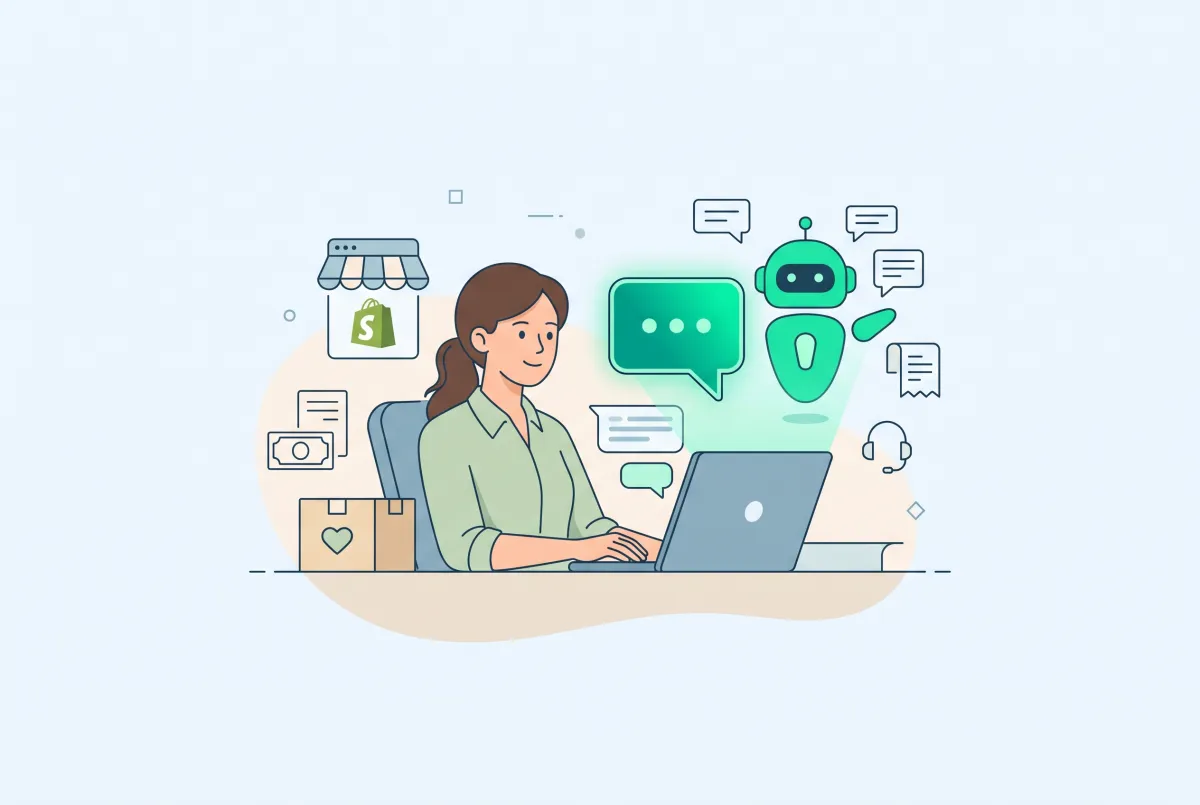
It's 2am and your phone buzzes. Someone wants to know where their order is, and right now the only person standing between that message and your sleep is you. That's the reality of running a store alone, and it's exactly why AI chat support for solo Shopify founders has stopped being a nice-to-have. When you're the founder, the packer, the marketer, and the support desk, every ping costs you attention you can't get back.
Roughly 82.7% of Shopify merchants have 10 or fewer employees, based on an analysis of nearly 81,000 stores. Most of us are running lean, and a lot of us are running solo. So the question isn't whether you should automate support. It's how to do it without losing the personal touch you built the brand on.
Why does customer support break solo Shopify founders before anything else does?
Support breaks solo founders because it never stops, and it always arrives at the worst moment. You can batch fulfillment. You can schedule your marketing. But a customer question shows up whenever the customer feels like asking, and it demands an answer now.
The bigger problem isn't the number of tickets. It's the context-switching. You're editing a product page, then a chat pops up, and suddenly your brain has to leave that task, load the customer's order history, respond, and try to remember where you were. That mental tax adds up fast.
This matters because burnout in this crowd is common. Research on founders shows 70% of entrepreneurs are affected by mental-health problems, with 34.4% reporting burnout. When there's no team to hand things off to, every one of those interruptions lands on the same set of shoulders. Yours.
What does a typical day of support look like when you're a one-person store?
It looks like death by a thousand small questions. Most of what hits your inbox isn't complex, it's repetitive: sizing, shipping times, return policy, and above all, "where's my order?"
That last category is enormous. Order-status queries alone (WISMO, short for "where is my order") make up 20 to 40 percent of total ecommerce support tickets, and that can climb past 50% during peak season. You already know the answer to every one of them. The tracking link is right there. But you still have to stop what you're doing and paste it.
Now stack that against what customers expect. Per the Zendesk CX trends data, 74% of consumers expect 24/7 service and 88% expect faster responses than the year before. A solo founder physically cannot be awake at 2am answering chats. Something has to give, and usually it's your evenings, your focus, or your sanity.
How does AI chat support for solo Shopify founders actually work without sounding like a robot?
AI chat works by reading your store's own content and answering from it. Instead of guessing, a good tool pulls from your product pages, collections, shipping policy, and FAQ, then responds in a chat widget on your storefront. If you've ever wondered how these tools fit together, our guide on how AI chatbots automate Shopify support breaks down the general mechanics.
The "doesn't sound like a robot" part is on you, not the software. The AI is only as good as the material you feed it. If your knowledge base reads like a legal document, the answers will too.
Here's the fix that most people skip: write your knowledge base in your own voice. If you'd normally tell a customer "Hey, that usually ships within two days, I'll get it out Monday," then write it that way. The AI mirrors your tone when your source material has a tone. Feed it a stiff bullet list and you get stiff replies.
This is also where the emotional friction shows up. A lot of founders feel guilty automating support because being personally responsive was part of the brand promise. That guilt is fair, but it's aimed at the wrong target. You're not outsourcing your voice. You're recording it once so it can answer at 2am while you sleep.
Which questions should AI handle, and which ones still need you?
AI should handle anything with a fixed, knowable answer. That's most of your volume. Order status, shipping timelines, sizing, materials, care instructions, return windows, and stock questions all have correct answers that don't change based on mood or judgment.
You should keep the messy stuff. Anything involving a judgment call, an exception to policy, an upset customer, or money moving in the wrong direction needs a human. Here's a rough split to configure:
- Let AI answer: tracking links, shipping estimates, sizing charts, return-policy explanations, product specs, and stock availability.
- Escalate to you: refund disputes, damaged or lost orders, address changes after shipping, wholesale or bulk requests, and anything where the customer sounds frustrated.
Set escalation rules explicitly. When the AI hits a question it can't source an answer for, it should collect the customer's email and flag the chat for you rather than inventing something. A tool that guesses on a return policy will create a mess you have to clean up personally.
Those instant answers do more than save time, they save sales. When a shopper hesitates over shipping speed and gets an immediate reply, they check out instead of bouncing. We dug into that in our piece on how AI chat recovers carts lost to unanswered questions.
How do you set this up in a weekend without a developer or a big budget?
You can do this in a weekend for free, no developer required. Most AI chat apps install from the Shopify App Store, connect to your store data automatically, and drop a widget on your theme without touching code.
Here's a realistic no-budget path:
- Install an AI chat app from the Shopify App Store and connect it to your store. It reads your products and pages on its own.
- Write your rules document. Spend an hour turning your most-asked questions into plain-language answers in your voice. This is the highest-leverage step, so don't rush it.
- Add your policies. Paste in shipping timelines, return windows, and any exceptions. Vague policies produce vague answers.
- Set escalation triggers for refunds, damaged orders, and anything the AI can't source.
- Test it like a customer. Ask it the ten questions you get most and fix any answer that sounds off.
One tool built for exactly this is RagChat: AI Chatbot & Livechat, which pulls answers straight from your products, collections, and pages, then hands off to a shared human-plus-AI inbox when a chat needs you. Its free plan covers unlimited AI replies for up to 200 products, so a small catalog can start without paying anything. That's the whole point: you set it up once and it answers while you're asleep.
If you want a full step-by-step, our 2026 checklist for setting up live chat and AI support walks through the widget install and configuration in detail. Keep your stack lean while you're at it, our roundup of the only Shopify apps you actually need can help you avoid app bloat.
What's the real cost of AI chat versus your first support hire?
The gap is enormous, and it's the whole reason this works for solo founders. AI chat plans commonly start free and run roughly $14 to $39 a month for more products and sources. A support hire does not.
The average US customer service representative earns $38,264 a year, about $18 an hour. That's the salary AI chat is designed to postpone. Even part-time, a human rep is a real monthly line item that a bootstrapped store often can't justify.
Per-ticket economics tell the same story. Analysis of AI support deployments puts the cost of a human-handled ticket at $8 to $12 versus $0.50 to $1.05 for an AI-handled ticket, a difference of 12 to 24 times. Small businesses also see the fastest results: the same source reports a 3 to 5 month payback window and 73% reporting positive ROI on their first deployment.
Speed is part of the value too. Across implementations, AI has cut first response times from over six hours to under four minutes, and resolution times from 32 hours to 32 minutes, a 98% improvement. No solo founder can match that by hand.
How do you know when AI chat support isn't enough and it's time to hire?
You'll know it's time when the escalations, not the total tickets, start eating your day. AI can absorb near-infinite volume of routine questions. The signal to hire is when the human-only pile grows past what you can clear.
Watch for these concrete thresholds:
- Escalation rate: if more than 20 to 30% of chats need a human and you're clearing them late at night, you're past capacity.
- Response lag on humans-only tickets: when your reply time on escalated issues stretches past a day consistently, customers feel it.
- Revenue headroom: once support is genuinely costing you sales or reviews, a part-time hire pays for itself. If a rep's roughly $38,000 salary is a small fraction of revenue, the math works.
Growth changes the picture on the operations side too. If order volume is climbing fast, read our take on building a store that handles 10x traffic without crashing so your infrastructure doesn't break before your support does.
What do solo founders wish they knew before automating support?
The biggest lesson: don't aim to never look at support again. That's the fantasy most AI content sells, and for a solo founder it's the wrong goal. Full automation with zero daily touchpoint means you lose your single best source of product feedback.
Here's my hot take. The win isn't "set it and forget it." The win is cutting your daily support time from four hours to twenty minutes while still reading enough to stay dangerous. Your own tickets are an early-warning system. A wrong sizing chart, a carrier that's suddenly late, a product photo that's misleading, you catch all of it by skimming chats. Automate the answering, not the noticing.
A few more things founders learn the hard way:
- The knowledge base is the product. A mediocre AI with a great rules document beats a great AI with a lazy one. Invest the hour.
- Wrong answers are relationship damage. When AI misquotes a return policy and there's no manager to escalate to, you personally repair that trust. Bound the AI tightly and let it say "let me get the founder on this" instead of guessing.
- Support automation is a gateway. Once chat runs itself, you'll want the same leverage everywhere. Our guide to AI agents and smart automation for Shopify shows where automation goes next, and if you're building fresh, setting up a whole store in a day with AI follows the same run-it-solo philosophy.
Solopreneurs aren't a fringe group anymore. There are 29.8 million solopreneurs in the US generating $1.7 trillion, and 74% had adopted AI tools by 2026. AI chat is how a one-person store answers like a ten-person team. Set it up once, keep reading enough to stay sharp, and give yourself back your evenings.

RagChat: AI Chatbot & Livechat
SponsoredAI chat that answers from your real products. Unlimited AI replies on the free plan.
Related Articles
How to Set Up Live Chat and AI Customer Support for a New Shopify Store (2026 Checklist)
Learn how to set up live chat and AI customer support for a new Shopify store, step by step, with the best AI app to automate support around the clock.
AI Chatbot for Shopify: How to Automate Customer Support and Increase Sales
Learn how an AI chatbot for Shopify automates customer support, recovers abandoned carts, and boosts sales with 24/7 replies and smart product upsells.
WISMO tickets can eat up to 50% of a growing Shopify store's support inbox. See how AI chat connected to real order data auto-answers them 24/7, for free.
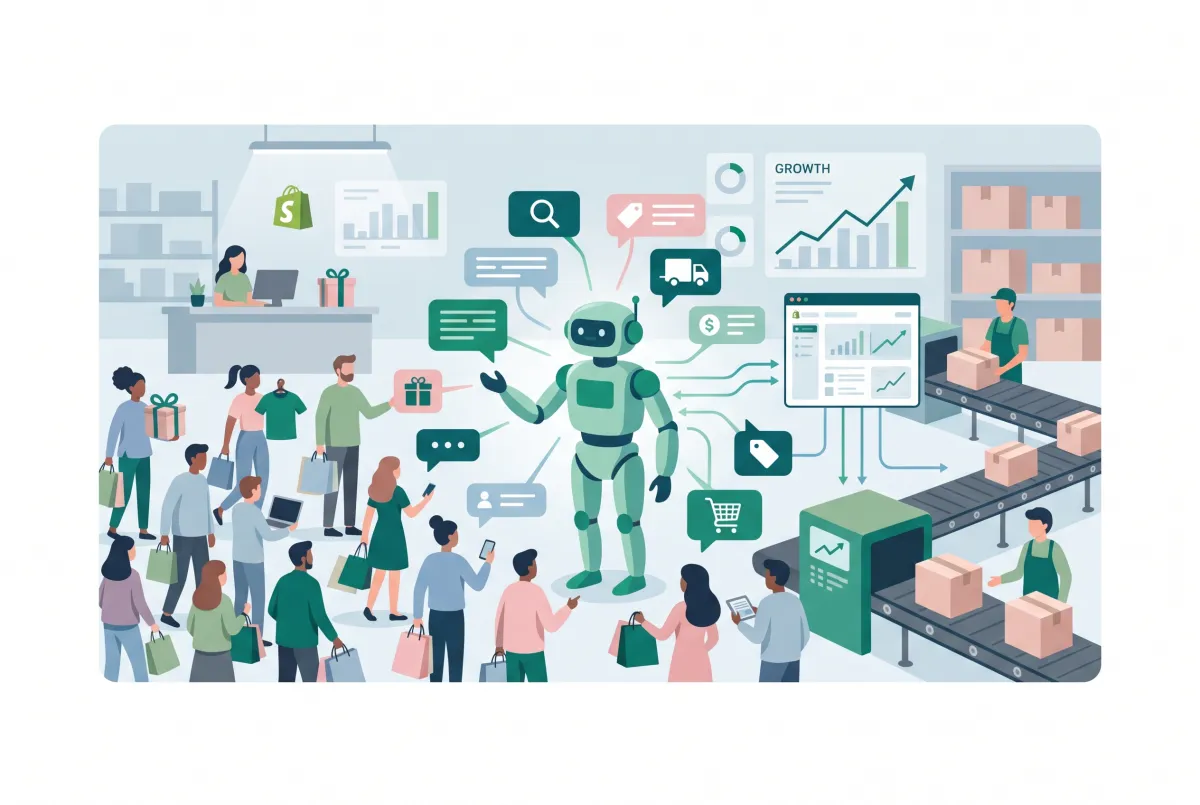
How AI Chat Handles BFCM Traffic Spikes for Shopify Stores Without Hiring Seasonal Staff
BFCM traffic can spike 5-10x overnight. See how AI chat handles Shopify Black Friday and Cyber Monday support without adding any seasonal support staff.
Most Shopify cart abandonment isn't price shock, it's an unanswered question. See how real-time AI chat answers objections before shoppers leave.
Shoppers with sizing, spec, or fit questions bounce without answers. See how AI product Q&A chat lifts Shopify conversion rates on complex catalogs now.