
Shopify Cart Abandonment: How AI Chat Recovers Sales Lost to Unanswered Questions
Why Do 7 in 10 Shopify Shoppers Abandon Their Cart?
Roughly 7 in 10 shoppers add items to a cart and never buy. The documented average sits at 70.22% across 50 studies, and that number has barely moved in a decade.
Here's the part most merchants miss. A big share of those exits aren't people who changed their minds about wanting the product. They wanted it. Something stopped them, and often it was a question they couldn't get answered fast enough.
This article is about the Shopify cart abandonment AI chat can actually recover: the carts lost to unanswered questions, not the ones lost to genuine "just browsing" behavior. If you're running an established store with real traffic and steady cart activity, that recoverable slice is where your next conversion lift hides. If you're standing up support from scratch instead, our guide on setting up live chat and AI support for a new store is the better starting point.
What's the Difference Between an Abandoned Cart and an Unanswered Question?
An abandoned cart is the symptom. An unanswered question is frequently the cause. Treating every abandonment the same way is why so many recovery efforts underperform.
Picture two shoppers. One adds a jacket, sees the total, and decides it's over budget. That's price abandonment, and no chat widget saves it. The second adds the same jacket, wonders whether it runs small, can't find a size chart, and leaves to "think about it." That shopper had money ready and intent locked in. They left over a 15-second information gap.
The second shopper is recoverable, and there are a lot more of them than merchants assume. When you separate the two groups, you stop wasting energy discounting your way out of problems that were never about price. That distinction is also why defaulting to a coupon is often the wrong move, something we cover in running a Shopify sale without destroying your margins.
This piece is deliberately conversion-focused. If you want the broader operational view of automating tickets, refunds, and post-purchase support, read our companion piece on using an AI chatbot to automate Shopify support. Here we're only chasing the sale that's slipping away right now.
Which Pre-Purchase Objections Actually Kill Shopify Sales?
Four objection categories do most of the damage: shipping cost and timing, sizing and fit, returns, and product compatibility. Each one is a specific question, and each one deserves a specific answer rather than a vague reassurance.
Shipping cost and timing
Unexpected costs are the single biggest killer. 39% of shoppers abandon because extra costs (shipping, tax, and fees) were too high, and another 21% leave because delivery was too slow. Notice that these are information problems as much as price problems. "Will this ship free?" and "Will it arrive by Friday?" are answerable in one sentence.
Sizing and fit
Fit uncertainty is brutal in apparel. Fashion carries the highest abandonment of any sector, and industry estimates put sizing issues behind as much as 70% of fashion returns. Every "does this run small?" that goes unanswered is either a lost sale now or an expensive return later.
Returns
A shaky returns policy quietly bleeds conversions. 15% of shoppers abandon because the returns policy wasn't satisfactory. The real problem is usually that the policy is fine but buried in a footer link nobody clicks, so the shopper assumes the worst.
Product compatibility and options
For anything technical or configurable, "will this work with my setup?" is the whole ballgame. Compatibility, bundle contents, material, and custom option questions stall carts constantly. If your variant and option data is messy, those questions can't be answered accurately, which is exactly why adding custom product options without breaking inventory matters more than it looks.
Why Doesn't Email Recovery Fix a Question-Driven Abandonment?
Email recovery fails question-driven abandonment because of timing. By the time your cart email lands, the shopper is gone, distracted, and cold. You're trying to answer a question hours after the moment they cared about it.
Think about the sequence. A shopper wonders whether the return window covers sale items. They can't find out, so they leave. Ninety minutes later an email arrives saying "you left something behind" with a 10% code. That email never addresses the actual objection, and the discount trains buyers to abandon on purpose.
Email absolutely has its place for genuine reminders and re-marketing. But it operates after the fact. The objection needed answering while the shopper was still on the product page with their card in hand, not in their inbox an hour later.
How Does Real-Time AI Chat Answer Objections Before a Shopper Leaves?
Real-time AI chat closes the information gap at the exact moment it opens. Instead of hoping the shopper hunts through your policy pages, the answer comes to them in a conversation while they're still deciding.
The impact of on-site conversation is well documented. Tidio's research roundup found live chat interactions are linked to a 10% increase in average order value, and that 38% of customers are more likely to buy from a store that offers live chat. That lift comes from removing hesitation before it hardens into an exit.
AI extends this beyond staffed hours. A human team can't watch every cart at 2am, but an AI agent answers instantly, every time, without a queue. The priority isn't replacing your team. It's making sure no question ever goes unanswered long enough to become an abandonment.
This is a different job from generic support automation. Broader AI workflows, from tagging tickets to routing orders, are worth exploring too, and our overview of AI agents for Shopify covers that wider automation opportunity. For cart recovery specifically, the single skill that matters is answering pre-purchase objections accurately and fast.
Can AI Chat Actually Read Your Store's Catalog and Policies Accurately?
Yes, but only if it's built to answer from your own data rather than a generic script. This is the difference between a chatbot that says "our sizes generally run true to fit" and one that says "the Aria dress runs small, size up if you're between sizes," pulled straight from that product's page.
Modern retrieval-based tools index your live products, collections, and policy pages, then answer from that source. Apps like RagChat: AI Chatbot & Livechat are built for exactly this, answering pre-purchase product and policy questions in real time from your store's actual catalog. So a shopper asking "what's your return window on sale items?" gets your real policy, not a hallucinated guess. RagChat's free tier covers up to 200 products, which is enough to test the recovery effect before committing.
Here's the uncomfortable truth most "chatbot reduces abandonment" content skips: an AI chatbot is only as good as your product data. If your size charts are missing, your return policy is a buried footer link, or your options are a mess, no AI can answer the question that's costing you the sale. Merchants who install a bot before fixing catalog hygiene are optimizing the wrong end of the funnel.
Accurate answers require accurate inputs. That means structured sizing data, clean variant options, and complete product attributes. If your options are limited by Shopify's native constraints, the fix is upstream, which is why Shopify's product option limitations directly affect whether your AI can answer fit questions at all. The same discipline that powers a complete product page SEO setup, full specs, clear policies, structured data, is what feeds the AI good answers.
Reviews are the complementary layer here. Reviews answer "does this run true to size?" at scale for the average shopper, while AI chat handles the individual edge case in the moment. Building that review base is worth the effort, and our guide on how product reviews increase Shopify conversion rates pairs neatly with chat as a two-part objection-handling system.
What Does This Look Like in Practice?
In practice, AI chat turns a silent exit into a short conversation that ends in checkout. Here are three of the most common recovery moments, drawn from the objection categories above.
Shipping cost. A shopper adds two items and hovers, unsure about shipping. They ask, "How much is shipping to Texas?" The AI replies that orders over $50 ship free and their cart already qualifies. The hesitation evaporates and they check out.
Sizing. A shopper likes a pair of boots but isn't sure of the fit. They ask, "Do these run true to size?" The AI pulls the product's fit note and recent review sentiment: "They run slightly narrow, most reviewers with wide feet sized up half a size." That's an answer a generic bot can't give.
Return window. A shopper eyeing a discounted jacket asks, "Can I return this if it's on sale?" The AI reads your actual policy and confirms sale items are returnable within 30 days for store credit. Objection cleared, sale saved.
Each exchange takes seconds and resolves the exact friction that would have ended in an abandoned cart. None of it required a discount, and none of it required a human awake at the right minute.
How Do You Measure Whether AI Chat Is Actually Recovering Carts?
Measure it by comparing conversion rate for chat-engaged sessions against non-engaged sessions, then watch your overall abandonment rate over time. If shoppers who talk to the AI convert meaningfully higher, the tool is doing its job.
Track these signals specifically:
- Conversion rate of chat-engaged sessions versus the site average, your clearest lift indicator.
- Abandonment rate trend before and after launch, benchmarked against that 70.22% average.
- Question categories the AI handles most, which tells you where your product pages are failing shoppers.
- Handoff and "I don't know" rate, a direct read on gaps in your catalog data.
That last metric matters more than the flashy recovery numbers. When the AI can't answer, it's usually because your data is stale or missing: an out-of-date inventory count, an absent sizing chart, a custom option with no description. Every unanswered question is a to-do item for your catalog, not proof the tool failed.
On recovery rates themselves, be skeptical of big vendor claims. Industry reporting suggests AI-powered chat recovers roughly 20 to 35% of abandoned carts versus 5 to 8% for email alone, but that figure traces to vendor case data rather than independent research, so treat it as directional. Your own before-and-after conversion numbers are the only benchmark that counts. Fix your data, answer the question in real time, and the recovered carts follow.

RagChat: AI Chatbot & Livechat
SponsoredAI chat that answers from your real products. Unlimited AI replies on the free plan.
Related Articles
Shoppers with sizing, spec, or fit questions bounce without answers. See how AI product Q&A chat lifts Shopify conversion rates on complex catalogs now.
Sizing, fit, and spec questions no one answered drive most returns. Learn how to reduce Shopify product returns with AI chat before an order ever ships.
AI Chatbot for Shopify: How to Automate Customer Support and Increase Sales
Learn how an AI chatbot for Shopify automates customer support, recovers abandoned carts, and boosts sales with 24/7 replies and smart product upsells.
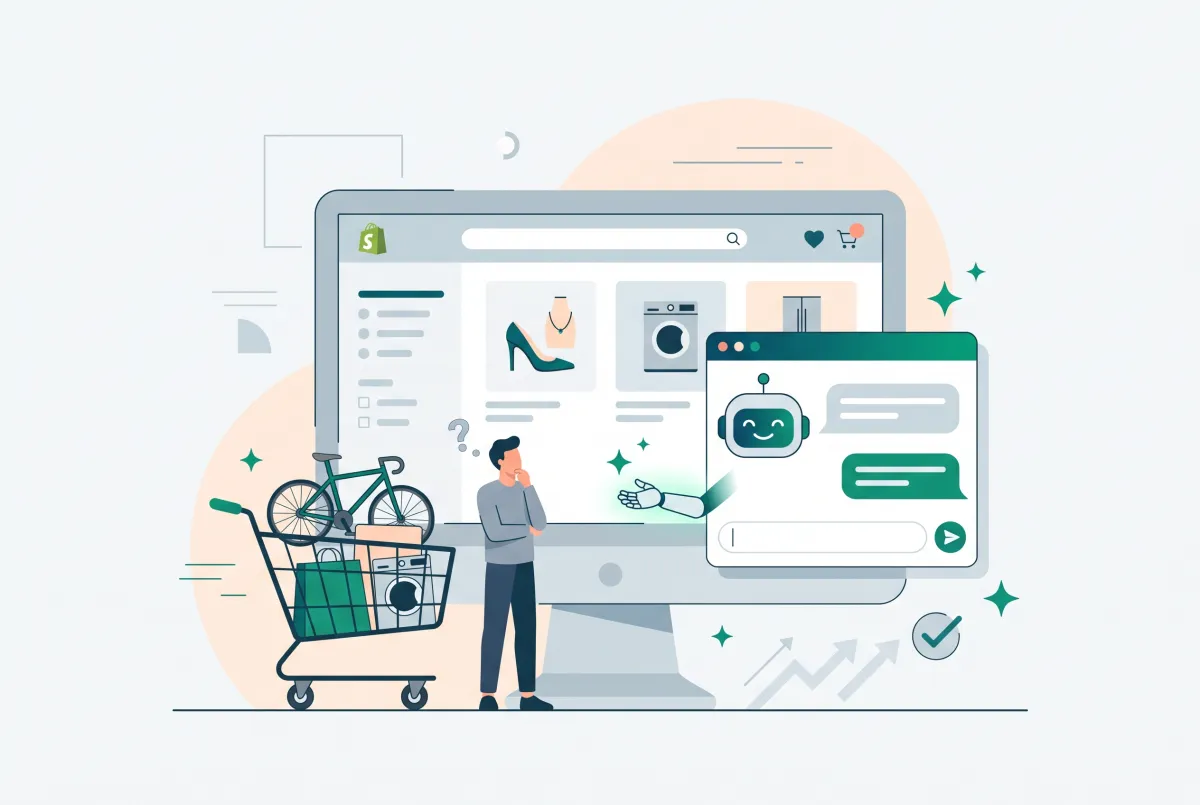
AI Chat for High-Ticket Shopify Stores: How to Answer the Questions That Stall a $2,000 Sale
High-ticket buyers stall on questions no FAQ page answers. Learn how AI chat for high-ticket Shopify stores handles objections and closes $2,000 sales.
WISMO tickets can eat up to 50% of a growing Shopify store's support inbox. See how AI chat connected to real order data auto-answers them 24/7, for free.
AI chat support for solo Shopify founders handles repetitive questions 24/7, so you can skip hiring, dodge burnout, and keep sounding like yourself daily.