
How to Reduce Shopify Product Returns With AI Chat (Before the Order Ships)
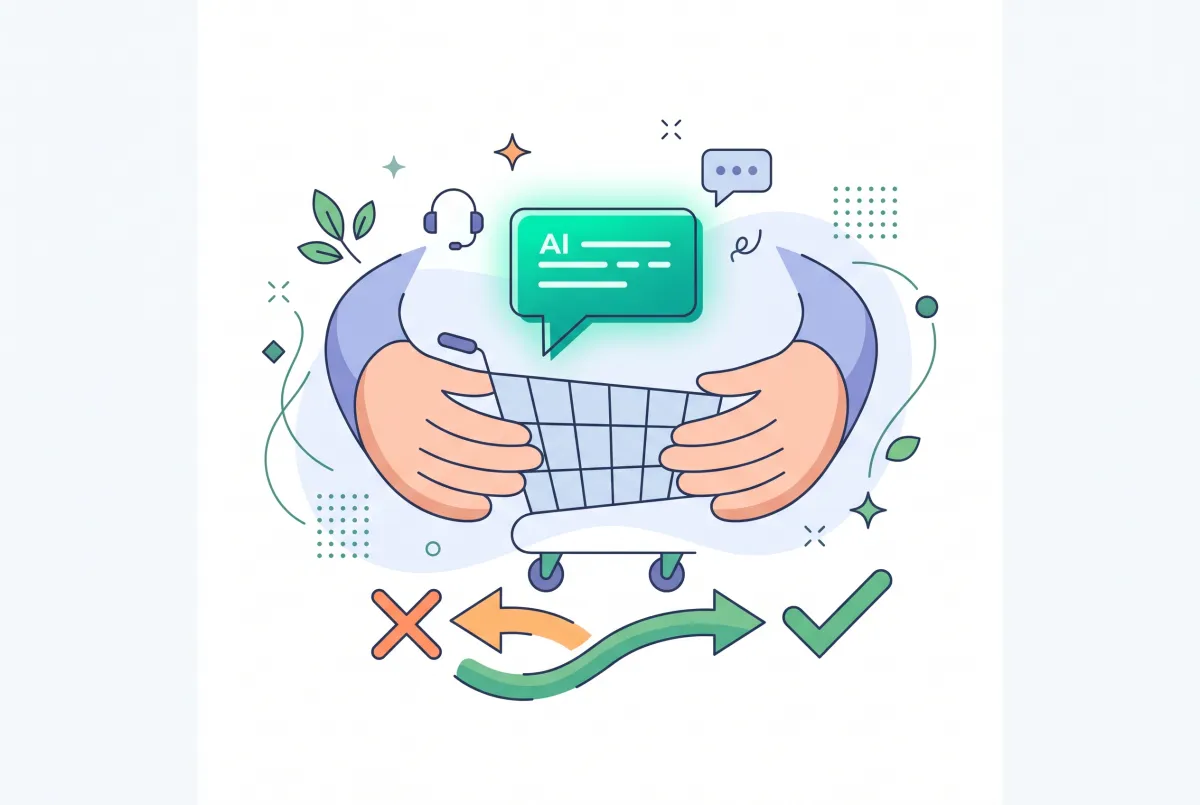
Most returns are not decided in the returns portal. They are decided on the product page, days earlier, when a shopper had a question about fit, material, or compatibility and nobody answered it. If you want to reduce Shopify product returns with AI chat, the leverage point is not the RMA workflow or the prepaid label. It is the thirty seconds before checkout when a customer is quietly unsure and clicks "buy" anyway.
Almost every article about AI and returns talks about post-purchase automation: exchange flows, refund status, return labels. That is cleanup. It makes you faster at processing mistakes you already shipped. This piece is about the opposite side of the timeline, using an AI chatbot for your Shopify store to catch the doubt that turns into a return, before the order is ever placed.
Returns are expensive, growing, and largely preventable. Let's break down why they happen, what they actually cost, and how a chatbot that answers from your real product data quietly shrinks your return rate week after week.
Why Do So Many Shopify Orders Come Back as Returns?
Online orders come back at roughly two to three times the rate of in-store purchases because shoppers can't touch, try on, or test anything before buying. The National Retail Federation estimated that 19.3% of online sales would be returned in 2025, part of a projected $849.9 billion in merchandise returned across retail overall. Nearly one in five ecommerce orders bounces back.
Compare that to physical retail. In-store return rates sit around 5 to 8.9%, while ecommerce runs 19 to 20.5%, according to analysis from EightX. That gap is not random. It maps almost perfectly to the questions a physical store clerk answers that your product page does not.
Think about what happens in a good brick-and-mortar shop. You hold the fabric, ask "does this run small?", and get an honest answer on the spot. You check whether the cable fits your laptop before you pay for it.
A staff member closes the uncertainty gap in real time. Online, that gap stays open, and an open uncertainty gap is a coin flip that often lands on "return it."
ReturnZap's Shopify-specific data shows return rates vary widely by category, and notes that many Shopify retailers actually run below the broader ecommerce average when their listings are strong. You can see the pattern in their Shopify return rate benchmarking. The stores that keep returns low are the ones that answer buying questions before checkout, not after.
Here is the uncomfortable part. Most returns are not caused by bad products.
They're caused by information that existed somewhere in your business but never reached the shopper at the moment they needed it: a size chart buried in a tab, a compatibility note that lived only in your head, a fabric weight nobody ever wrote down anywhere a shopper could find it.
What Does a Single Return Actually Cost Your Store?
A single return costs far more than the return shipping label. Ringly's 2026 return statistics put the all-in cost of processing one return between $10 and $65 per item, once you factor in shipping both ways, labor, inspection, and restocking.
On a $50 product, that is a fifth of the sale price to more than the entire thing, gone, before you even account for the margin you thought you'd keep. And that assumes the item comes back sellable. Anything opened, worn, or damaged in transit gets discounted, liquidated, or written off entirely.
Certain categories are brutal. Richpanel notes reverse logistics alone can run $30 to $65 per item for electronics, and for furniture specifically, it can exceed the product's own margin. The math gets ugly fast on anything low-margin or bulky.
Now stack this on a small or mid-size Shopify store. You are not a big-box retailer with a returns warehouse and a logistics team absorbing the hit.
Every return you process is your time, your packaging, your restocking labor, and your cash flow. A 20% return rate on a lean operation is not a rounding error. It is the difference between a profitable month and a break-even one.
This is the hot take that most merchants resist. Returns are not a shipping problem to clean up after the fact. The return was already decided back on the product page, not in the box.
If your listing can't answer "will this actually fit me" or "will this work with what I already own" as well as a knowledgeable clerk could, you are not fixing returns by processing them faster. You are just getting more efficient at shipping out mistakes you already knew were coming.
Which Pre-Purchase Questions Predict a Return Before It Happens?
Certain questions are return warnings in disguise, and the biggest one is about fit and sizing. Fit and sizing uncertainty is widely considered the top driver of apparel and footwear returns, the exact categories that post the highest return rates in the category data covered below. When a shopper asks whether something runs small, they are telling you they are about to gamble.
These predictive questions cluster into a handful of types. Learn to recognize them, because each one is a return that has not happened yet.
- Fit and sizing: "Does this run small?" "I'm between sizes, which should I get?" "Is this a slim or relaxed cut?"
- Material and texture: "Is this thick or thin?" "Will it itch?" "Is the leather real or vegan?"
- Compatibility: "Will this work with my 2023 MacBook?" "Does this fit a standard US outlet?" "Is this compatible with model X?"
- Appearance and expectation: "Is the color as bright as the photo?" "What does this shade look like in daylight?" "How big is it really?"
Every one of these is a moment where the shopper is trying to close their own uncertainty gap. If they get a clear answer, they either buy the right thing or decide it is not for them. Both outcomes are wins. A confident purchase sticks, and a well-informed non-purchase never becomes a return.
There is an important distinction here that merchants constantly blur. An unanswered pre-purchase question has two possible failure modes.
Either the shopper leaves without buying, which is cart abandonment you can recover with AI chat, or they buy anyway on a hopeful guess and send it back later. Same unanswered question, two different leaks. This article is about the second one.
The pre-purchase Q&A angle is where the leverage lives, and it is exactly where a bot that pulls from real product data shines. A generic scripted chatbot that answers "great question, please contact support" does nothing. A bot that reads your actual size chart and says "this style runs about half a size small, so size up if you're between" prevents the return on the spot. Apps built for this, like RagChat, answer from your real products, collections, and pages rather than a canned script, which is the whole difference between deflecting a shopper and actually resolving their doubt.
How Do You Reduce Shopify Product Returns With AI Chat Before the Order Ships?
You reduce Shopify product returns with AI chat by answering the fit, material, and compatibility question at the exact moment of doubt, so the shopper either buys the right variant or walks away informed. The mechanism is prevention, not recovery. You are intercepting the mistake before it becomes an order, not scrambling to reverse it afterward.
Here is the sequence. A shopper lands on a product page, feels a flicker of uncertainty, and instead of guessing or leaving, they type their question into a chat widget sitting right there on the page. The AI reads your product data, answers specifically, and the shopper makes a confident decision. No support ticket, no email thread, no 24-hour wait that kills the sale or forces a blind guess.
The accuracy of that answer is everything. A bot that hallucinates a spec is worse than no bot, because it creates a return on false information the customer now trusts. This is why the data source matters more than the chat interface. The bot has to be grounded in your real size charts, spec sheets, material notes, and product descriptions, not a large language model's general guess about what a "medium" usually means.
The Difference Between a Generic Answer and a Grounded One
Picture the same fit question hitting two different bots. A generic chatbot bolted onto a Shopify store without real product data answers something like "Great question! Sizing can vary by brand, so we recommend checking our general size guide for reference." That's technically true and completely useless. The shopper is exactly as unsure as before they asked, so they either guess or leave.
A bot grounded in that specific product's data answers differently: "Based on our fit notes, this style runs about half a size small compared to our other tees, so if you're a true medium, we'd suggest sizing up to a large." One answer resolves the doubt in the moment. The other just moves the same doubt downstream, into either a lost sale or a return you'll be processing in three weeks.
The gap between those two answers is the entire business case for feeding a chatbot real product data instead of treating it as a generic support widget. A confident, specific answer costs you nothing extra to deliver once it's set up. A vague one costs you a return, a refund, and a customer who isn't sure they'll order from you again.
Industry data backs this up. Retailers using AI-powered fit prediction see roughly 27% fewer size-related returns, according to Envive's compilation of AI return-reduction statistics. The gains only show up when the shopper actually gets a complete, accurate answer, which again comes back to feeding the bot good data.
Prevention also compounds in a way that post-purchase automation never does. When you speed up your return processing, you get a faster return, but you still eat the cost. When you prevent the return, that cost disappears entirely and stays gone for every future shopper who asks the same question. One good answer, delivered a thousand times automatically, is a very different economic engine than one refund processed a thousand times.
Speeding up returns makes you efficient at losing money. Preventing them makes you profitable. The chat conversation that never turns into a return is worth more than the smoothest RMA flow you'll ever build.
One more clarification, because merchants love to conflate metrics. Returns prevented is its own number. It is not conversion lift, and it is not cart-abandonment recovery.
A chatbot can do all three at once, but you should measure "orders that would have come back and didn't" separately from "extra checkouts you captured." Blend them and you'll never know which lever is actually working.
How Does This Play Out for Apparel, Footwear, Electronics, and Beauty Products?
Return rates and the questions that drive them differ sharply by category, so the chat answers that prevent them differ too. Claimlane's category data puts apparel returns at 24 to 40%, footwear at 20 to 35%, electronics at 15 to 20%, and beauty at 5 to 8%. Each category fails for a different reason, and each needs a different kind of answer.
Apparel: the "does this run small?" problem
Apparel is the worst offender, and sizing is nearly always the cause. A shopper asks "does this run small?" and the AI answers from your actual size chart plus any known fit notes: "This style runs about half a size small. You're usually a medium, so I'd go large for this one." That single exchange turns a coin-flip purchase into a confident one.
The bot can go further. It can ask a clarifying question back, like "what's your usual size and how do you like the fit?" and then recommend the specific variant. That is a store clerk conversation, automated, on every product page, at 2 a.m.
Footwear: fit and comfort you can't feel through a screen
Footwear returns hinge on fit and comfort, things a photo can't convey. Good chat answers pull from width notes, arch support details, and break-in expectations. "These run true to length but narrow, so if you have a wide foot, size up or check our wide fit" prevents the most common footwear return before it starts.
Electronics: the compatibility trap
Electronics come back because of compatibility, not defects, and compatibility is a factual question a bot answers perfectly. "Will this dock work with a 2023 MacBook Pro?" has a right answer buried in your spec sheet, and the AI can surface it instantly. This is exactly the complex-catalog scenario where AI product Q&A chat lifts conversion on complicated products while cutting the returns that come from spec mismatches.
The stakes are high because electronics reverse logistics are expensive. Preventing one compatibility return can save $30 to $65 in handling alone, which makes accurate spec answers one of the highest-ROI things a chatbot does.
Beauty: shade, texture, and the daylight problem
Beauty has the lowest return rate of the four, but shade mismatch and texture surprises still drive most of what comes back. "What does this shade actually look like in daylight versus the photo?" is a classic. A bot trained on your shade descriptions, undertone notes, and customer-reported comparisons can steer someone to the right match instead of a hopeful guess that gets returned half-used.
Across all four categories, the pattern holds. The return was going to be caused by a specific unanswered question, and the answer already existed in your business. The chatbot's job is to deliver that answer at the decision point, every time, without you being awake to do it.
How Do You Set Up (and Measure) an AI Chatbot That Prevents Returns on Shopify?
Setup comes down to two things: feeding the bot accurate product data and placing the widget where buying decisions happen. Both are non-negotiable. A brilliant bot fed thin data gives confident wrong answers, and a well-fed bot hidden in a corner never gets asked the question that matters.
Start with the data. Your chatbot can only be as accurate as what it reads, so audit these sources first:
- Size charts: Make sure they exist as structured, readable content on the product page or in a linked page the bot can access, not baked into a flat image the AI can't parse.
- Spec sheets: Dimensions, materials, compatibility, power requirements, and care instructions written out as text, ideally in Shopify metafields so they attach to the right products.
- Product descriptions: Fit notes, material weight, and texture details spelled out. If your copy is vague, the bot is vague.
- Product feed data: Variants, options, and inventory so the bot recommends the right SKU and doesn't push something out of stock.
This is where an app that grounds its answers in real store data earns its place. RagChat learns from your actual products, collections, and pages, and answers from that instead of a scripted tree, which is what makes it accurate enough to prevent a return rather than cause one. Its free plan includes unlimited AI replies and learns up to 200 products, which covers a lot of small and mid-size catalogs without a monthly bill. For a broader walkthrough of getting chat live, this Shopify live chat and AI support setup checklist covers the operational side.
Placement matters as much as data. The widget should live on the product page, near the buy button and the size chart, not just as a floating support bubble in the corner that shoppers mentally file under "complaints." You want it present at the exact spot where doubt appears. A shopper hovering over "add to cart," unsure about size, should see the chat prompt right there, not have to hunt for help.
While you're structuring this data, you're also doing your SEO a favor. The same clean size charts, specs, and metafields that feed the bot are what a strong product page needs to rank, and the Shopify product page SEO optimization checklist walks through structuring exactly this. Better data serves both goals at once.
How do you measure whether it's actually working?
Track returns prevented as its own metric, isolated from conversion and abandonment. The cleanest method is to compare the return rate on products with heavy chat activity against similar products without it, over a full fulfillment cycle plus your return window, usually four to eight weeks before the data is trustworthy.
Say you sell a jacket that historically returns at 30%, well above your store average, and chat logs show dozens of shoppers asking about true-to-size fit before you added the widget. Once the bot is live and answering that exact question from your fit notes, you'd track that one product's return rate specifically over the next couple of months rather than looking at your storewide average, which will move too slowly and get muddied by every other product's returns.
Watch three numbers. First, return rate on chat-active products versus baseline. Second, the volume of pre-purchase fit, spec, and compatibility questions the bot handles. Third, and this is the compounding one, the patterns in your chat logs.
Your chat logs are a map of exactly where your listings fail. If forty people ask "does this run small?" on one product, that listing is missing a fit note, full stop. This is the loop most merchants never close: use the log data to fix the root-cause listing, not just deflect the question. Digging into what your Shopify chatbot logs reveal about product demand turns the bot from a band-aid into a diagnostic tool.
Then fix the listing itself. If shoppers keep asking about material weight, write it into the description. If they keep asking about compatibility, add a compatibility section. Rewriting that copy the right way is its own skill, and writing Shopify product descriptions that rank and convert covers how to bake those answers in. Now the answer is on the page for everyone, including the shoppers who never open chat, and the chatbot handles the stragglers.
That is the full system. Feed the bot real data, put it where decisions happen, measure returns prevented separately, and mine the logs to fix the listings that generate the questions. Deflection stops one return. Fixing the listing stops the next hundred. Do both, and your return rate stops being a cost you absorb and starts being a number you actively drive down.

RagChat: AI Chatbot & Livechat
SponsoredAI chat that answers from your real products. Unlimited AI replies on the free plan.
Related Articles

Shoppers with sizing, spec, or fit questions bounce without answers. See how AI product Q&A chat lifts Shopify conversion rates on complex catalogs now.
Most Shopify cart abandonment isn't price shock, it's an unanswered question. See how real-time AI chat answers objections before shoppers leave.
AI Chat for High-Ticket Shopify Stores: How to Answer the Questions That Stall a $2,000 Sale
High-ticket buyers stall on questions no FAQ page answers. Learn how AI chat for high-ticket Shopify stores handles objections and closes $2,000 sales.
AI Chatbot for Shopify: How to Automate Customer Support and Increase Sales
Learn how an AI chatbot for Shopify automates customer support, recovers abandoned carts, and boosts sales with 24/7 replies and smart product upsells.

WISMO tickets can eat up to 50% of a growing Shopify store's support inbox. See how AI chat connected to real order data auto-answers them 24/7, for free.

How Product Reviews Increase Shopify Conversion Rates (And How to Get More of Them)
Product reviews can lift Shopify conversion rates by up to 380%. Learn how reviews, photos, and UGC turn browsers into buyers, with data to back it up.