
How AI Chat Reduces WISMO (Where Is My Order) Tickets for Shopify Stores
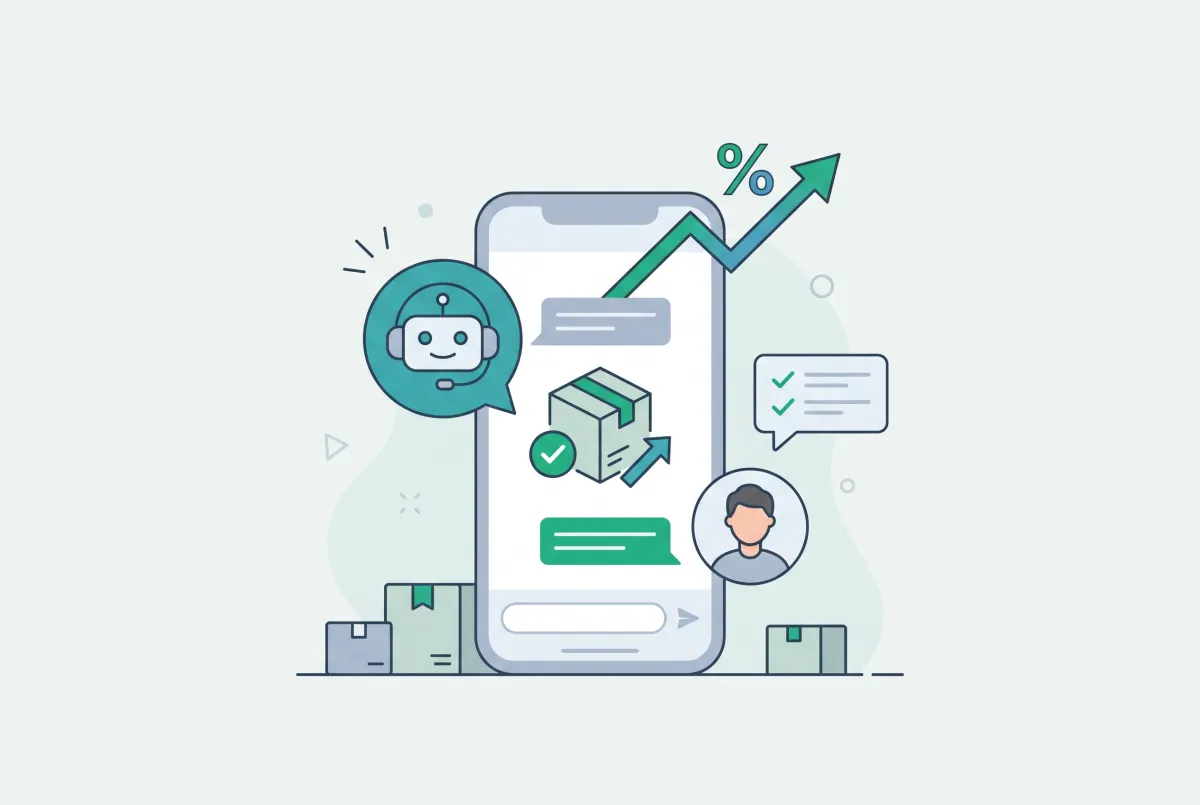
A customer places an order on Tuesday. Thursday morning they're back on your site, typing "where is my order?" into the chat bubble, even though the tracking email is sitting in their inbox. Multiply that by a few hundred orders a month and your support queue becomes one question asked a hundred different ways.
Cutting WISMO tickets with Shopify AI chat is one of the few support fixes that pays off in the first week, because the answer already lives in your admin. It just isn't reachable at the exact moment the customer asks.
Order status is the most automatable thing in ecommerce support. The questions repeat, the underlying data is structured, and the correct answer is identical every single time. That's the same reason AI chatbots work well for Shopify support in general, but shipping status is where the return shows up fastest.
One scoping note before we get into it. This article is about shipping and delivery status only. Returns, exchanges, and refunds run on completely different logic and deserve their own playbook, which we cover in reducing Shopify product returns with AI chat before the order ships.
What Is WISMO and Why Does It Flood a Growing Shopify Store's Inbox?
WISMO stands for "Where Is My Order," the industry shorthand for any customer message asking about shipping status, delivery timing, or a tracking number. It accounts for 30-50% of all DTC support contacts under normal conditions, climbing past 50% during peak season, according to Shopify's own merchant data.
The reason it dominates isn't that your customers are unreasonable. The stretch between "order confirmed" and "package in hand" is the only part of the buying experience where the customer has zero control and incomplete information, and people fill information gaps by asking.
Narvar's State of Post-Purchase report found that two-thirds of consumers feel a surge of anxiety right after clicking buy, and that 74% hit at least one late delivery in the past year. Anxiety plus a recent bad experience produces a message. Predictably.
Then there's checking behavior. Shoppers check tracking status an average of 3.6 times per shipment, rising to 5.2 times for orders above $150, per Narvar's behavioral data. Every one of those checks is an opportunity for confusion.
A scan that hasn't updated in two days, a status that reads "in transit" with no location, a delivery estimate that quietly slipped by 48 hours. Confusion converts into a support ticket. Shipping status can also climb to 50-70% of total contacts in dropshipping and consumer electronics, where transit times run longest and vary the most.
Why WISMO Grows Faster Than Your Order Count
Orders grow in a straight line. WISMO grows faster, and it usually happens somewhere between 200 and 2,000 orders a month for three predictable reasons.
- Transit times get longer and more variable. You add international shipping, a second fulfillment location, or a supplier who ships direct. More variance means more "is this normal?" messages.
- More handoffs enter the chain. Once a 3PL or a dropship partner is involved, tracking numbers appear later and update less reliably, which widens the silent window customers hate.
- Promotions compress everything. A flash sale squeezes a month of orders into three days, and all of those orders hit the "why hasn't it moved?" stage on the same schedule.
This is typically the moment a founder starts pricing out a part-time support hire. It's also the moment automation pays off most, which is why so many solo Shopify founders use AI chat to handle support instead of hiring.
How Much Are "Where Is My Order" Tickets Really Costing You?
Manually resolving a single WISMO ticket costs between $5 and $22 in agent time and overhead depending on the channel, while an AI-resolved conversation runs under $1. That's the business case in one sentence. The second-order costs are bigger than the per-ticket math suggests.
Run it on a realistic store. Say you field 400 support contacts a month and 40% are order status. That's 160 tickets. At a conservative $8 per agent-handled chat or email ticket, you're spending about $1,280 a month, or more than $15,000 a year, answering a question your Shopify admin already knows the answer to.
The time cost stings more than the dollar cost. Manual order-tracking lookups consume 60% to 70% of a support agent's time according to Salesforce data cited by Gladly. Your most experienced person, the one who actually knows your products, spends two-thirds of the day copying tracking numbers out of one tab and into another.
The Hidden Cost Is Tickets That Won't Stay Closed
WISMO tickets have a nasty habit of reopening. A customer asks, waits four hours, gets a link, clicks it, sees nothing has moved, and replies again. Now you're paying twice for the same question.
Gladly's data shows the gap between AI-resolved and agent-handled reopen rates at two different brands. A fintech brand saw AI-resolved order status conversations reopen 17.3% of the time versus 32.9% for agent-handled ones, and a home décor retailer saw 18.4% versus 24.3%. Both pairs run the same direction: AI answers stay closed more often. That looks backwards until you think about timing. An AI answer arrives while the customer is still staring at the screen, and it can be re-asked at 2am without a queue. A human reply lands hours later in a mailbox the customer has already stopped watching.
Peak Season Turns the Problem Into a Crisis
Post-BFCM, expect two to three times your normal WISMO volume. Carrier networks slow down at exactly the moment your order count spikes, so the two curves stack on top of each other, pushing order status well past half of total support contacts during peak weeks.
Seasonal support hires take weeks to recruit and train, cost real money, and are gone by mid-January. Automating status answers is cheaper and it compounds year over year, which is the same argument behind using AI chat to absorb BFCM traffic spikes without seasonal staff.
How Does AI Chat Connected to Real Order Data Actually Answer WISMO Questions?
It reads the order. A chat widget with permission to query your store's order data looks up the exact order the customer is asking about, pulls the fulfillment record attached to it, and writes a plain-language answer from those real fields instead of from a canned template.
Conceptually it's four steps, and understanding them is what separates merchants who get real deflection from merchants who install a widget and wonder why nothing changed.
Step 1: Verify Who You're Talking To
Order data is personal data, so the chat has to confirm identity before it says anything specific. On Shopify that's either a logged-in customer account session or an email address plus order number check. It's the same pattern Shopify already uses on its own order status page, where guests may be asked to verify their email or phone along with the order number.
Step 2: Find the Order
The app queries your orders through Shopify's Admin API using read access to order data, then matches the customer to their most recent order or to the specific one they mentioned by number. Multi-order customers are the edge case worth testing here, because "where's my order" from someone with three open orders needs a clarifying question, not a guess.
Step 3: Read the Fulfillment Record
Shopify's Fulfillment object exposes precisely what a WISMO answer needs. It carries status and displayStatus, trackingInfo (tracking company, tracking number, tracking URL), estimatedDeliveryAt, inTransitAt, deliveredAt, and an events list recording milestones across the shipment lifecycle.
That's a complete answer sitting in structured fields. Shopify also recognizes tracking numbers from hundreds of carriers worldwide and shows location updates for integrated carriers like DHL, UPS, and FedEx, so the data quality is usually better than merchants assume.
Step 4: Turn Fields Into a Sentence
Raw field dumps are useless to a nervous customer. The AI composes something a person would actually say: "Your order shipped Monday with UPS, tracking number 1Z999AA1, and it's out for delivery in Denver with arrival expected today."
Notice what didn't happen. The customer never left the chat window, never opened a new tab, never re-entered their order number on a third-party tracking page, and never waited for an agent. The whole exchange takes about eight seconds.
Why Real Order Data Prevents Wrong Delivery Estimates
Hallucinated ETAs are the fastest way to turn a mildly anxious customer into a furious one. A language model that only knows your shipping policy page will happily tell someone "3 to 5 business days" while their parcel sits in customs in Frankfurt. The customer takes that at face value, plans around it, and now you own a promise you never made.
Grounding is the fix. When the reply is assembled from trackingInfo and estimatedDeliveryAt on an actual fulfillment record, there's nothing left to invent. The model isn't predicting a delivery date, it's reading one.
The behavior that matters most is what happens when a field is empty. The correct response is honesty: "Your order is packed but hasn't been handed to the carrier yet, so there's no tracking number to share. Our processing time is 1 to 2 business days." Ask any vendor to demo that specific scenario before you commit. A confident guess is worse than an admission.
Tool choice matters more than feature lists here, because plenty of chat widgets answer FAQs beautifully and go blank the moment someone asks about a specific order. RagChat: AI Chatbot & Livechat answers from your real catalog and includes order tracking and unlimited AI replies on its free plan, with a shared human-plus-AI inbox for takeover available on paid tiers. Its order lookup covers the last 60 days of order history, which spans the window where nearly every WISMO question lands. If you're still testing whether automation can dent your status queue at all, starting on a free plan removes the "is this worth a subscription?" debate before you have data.
Why Do Static Tracking Pages and Old-Style Chatbots Fail to Stop WISMO Tickets?
Because both of them hand work back to the customer instead of taking work away. A branded tracking page is one more URL to find and one more form to fill in, and a rules-based chatbot is a decision tree that dead-ends the second a question doesn't match a preset button.
Most WISMO advice tells you to bolt on a branded tracking page or fire off more SMS notifications. That's a band-aid, not a fix. Customers don't want another link to click. They want an answer to their exact question, right now, in the same window where they're already typing. If your solution still requires the customer to leave the conversation and go hunt for information, you haven't solved WISMO. You've relocated it.
Break down where each approach leaks.
- Tracking pages answer the generic question. They show status. They don't answer "it says delivered but it isn't here," "can I still change the address," or "why hasn't it scanned in three days." Those are the questions that actually reach your inbox.
- Notifications are push, not pull. They fire on carrier scans. The anxious customer's question arrives in the silence between scans, which is exactly when there's nothing to push.
- Keyword chatbots break on phrasing. "Order status" hits the tree. "Hi, I ordered the blue one last week and it still hasn't turned up, my son's birthday is Saturday" does not.
- Multi-tool stacks fragment the answer. An SMS platform plus a tracking page plus a chatbot plus a voice agent is four subscriptions, four places to configure the same shipping policy, and four opportunities for those answers to contradict each other.
To be fair, proactive notifications genuinely work. Kai USA, the company behind Kershaw Knives, Zero Tolerance, and Shun Cutlery, cut weekly shipping and tracking inquiries by 92% using proactive email and SMS shipping notifications. That's a real result and you should absolutely have shipping notifications switched on.
But notice what notifications do. They reduce the number of questions asked. They don't answer the ones that still get asked. Ideally you run both, and if you can only do one this quarter, pick the one that answers questions.
How Do You Set Up AI Chat to Deflect WISMO Tickets Without Losing the Human Touch?
Connect order data first, then write your escalation rules before you write a single line of greeting copy. Deflection without a clean handoff path is how stores end up with lower satisfaction scores than they started with, and it's the most common self-inflicted wound in support automation.
Here's the build order that works.
- Install a chat app that can query orders and grant it read access to your order data. If the app can't read fulfillment records, it can't answer WISMO, no matter how good its writing is.
- Pick your verification method. Logged-in customer accounts give the smoothest experience. Email plus order number covers guest checkout, which is still most of your traffic on many stores.
- Feed it your shipping policy. Processing times, daily cutoff, carriers by region, international duties, weekend handling. This is what lets it answer pre-fulfillment questions where there's no tracking number to read yet.
- Define the "I don't know" rule explicitly. Instruct it to state what's missing and offer the human path rather than estimating. Then test that instruction, because instructions that aren't tested aren't real.
- Set escalation triggers before launch, not after the first complaint.
- Test against every order state you actually produce: unfulfilled, partially fulfilled, in transit, out for delivery, delivered, cancelled, refunded, and split across two shipments. Split shipments trip up more chat tools than anything else on this list.
- Place the widget where the panic happens. Product pages are the obvious spot, but post-purchase pages and your account area are where WISMO originates.
If you're building this into a store that doesn't have any chat in place yet, work through the full live chat and AI customer support setup checklist for a new Shopify store first. Order lookup is one layer on top of a working chat foundation, not a replacement for it.
Which WISMO Questions Should Still Go to a Human?
Any question where the next step costs money, requires judgment, or involves an unhappy person who has already asked once. The AI's job is telling the customer what is true. A human decides what to do about it.
Route these to a person every time:
- Marked delivered but not received. This needs a carrier claim, possibly a police report, and a goodwill decision about reshipping. Narvar found 41% of consumers have had a package stolen, so this comes up more than you'd like.
- Address changes after fulfillment. Carrier intercepts cost money and often fail. Nobody should promise this automatically.
- Customs holds and duty disputes. Documentation, money, and jurisdiction. Not an automation problem.
- Damaged on arrival. Photos, assessment, replace or refund. Judgment call.
- Chargeback or fraud signals. Anything that smells like a dispute goes straight to a person with full context.
- Third contact on the same order. Someone asking a third time is escalating emotionally, not informationally. Repeating the tracking status will make it worse.
That last rule is the one merchants skip, and it's the one that protects your satisfaction score. Set a counter. Two AI answers on a single order, then a human.
How Do You Measure Whether WISMO Tickets Are Dropping After a Shopify AI Chat Rollout?
Track order status contacts as a share of total contacts, not as a raw count, and measure against a 30-day pre-launch baseline. Raw counts move with order volume, so a growing store can cut WISMO share dramatically while the absolute number barely budges, and you'll wrongly conclude nothing worked.
Six numbers are worth watching every week:
- WISMO share of total contacts. Your headline metric. Tag tickets consistently or this number is fiction.
- AI resolution rate. The percentage of order status conversations closed with no human reply at all.
- Reopen rate. Compare against Gladly's benchmark of roughly 17-18% for AI-resolved versus 24-33% for agent-handled.
- Median first response time. Should collapse to seconds for status questions. If it hasn't, your verification step is probably too heavy.
- Escalation rate and reasons. The reasons are more useful than the rate. Repeated escalations for one cause mean a missing instruction, not a broken tool.
- Satisfaction split. AI-resolved versus human-resolved, scored separately. If AI scores lower on status questions specifically, your escalation triggers are too loose.
For a benchmark, brands running automated WISMO handling report support ticket volume dropping 35-50% within the first month of deployment. If you're 60 days in and nowhere close, the cause is almost always verification friction or widget placement rather than the AI itself.
Read the Transcripts, Not Just the Dashboard
Your chat logs are the cheapest operations research you will ever get, and almost nobody reads them. WISMO conversations cluster, and the clusters point straight at fulfillment problems your dashboards are hiding.
A spike in "still hasn't shipped" for one SKU usually means a backorder your inventory system hasn't surfaced. A cluster from a single region points at a carrier issue in that lane. Questions arriving before the shipping confirmation even goes out means your stated processing time is a lie, and fixing the copy will kill more tickets than any chatbot will.
This is the same underexploited goldmine we dug into in what your Shopify chatbot logs reveal about product demand. Deflection is the visible win. The operational intelligence is the bigger one.
What Should You Do About WISMO This Week?
Pull last month's support tickets and tag every order status one. That gives you a percentage, and the percentage tells you what to do next. Above 25% and automating status answers is the highest-return support project on your list, ahead of anything else you're considering.
Then connect a chat tool to your real order data, write your escalation rules before launch, and test the empty-tracking-number scenario until you trust the answer. Send your shipping notifications too. They shrink the question pool.
The economics aren't subtle. You're choosing between $5 to $22 of human time per answer and under a dollar of compute for the same answer delivered faster, at 3am, with a lower chance of being asked again. The main reason more stores haven't made that switch is that WISMO feels like a shipping problem, so it never gets treated as an automation problem. It's both, and only one half is cheap to fix.
When tickets mix WISMO with refunds and fraud noise, add a structured router before the chat reply. Our Jev AI Shopify store-ops guide covers confidence thresholds for that split.

RagChat: AI Chatbot & Livechat
SponsoredAI chat that answers from your real products. Unlimited AI replies on the free plan.
Related Articles
AI Chatbot for Shopify: How to Automate Customer Support and Increase Sales
Learn how an AI chatbot for Shopify automates customer support, recovers abandoned carts, and boosts sales with 24/7 replies and smart product upsells.

AI chat support for solo Shopify founders handles repetitive questions 24/7, so you can skip hiring, dodge burnout, and keep sounding like yourself daily.

How AI Chat Handles BFCM Traffic Spikes for Shopify Stores Without Hiring Seasonal Staff
BFCM traffic can spike 5-10x overnight. See how AI chat handles Shopify Black Friday and Cyber Monday support without adding any seasonal support staff.
Most Shopify cart abandonment isn't price shock, it's an unanswered question. See how real-time AI chat answers objections before shoppers leave.

How to Set Up Live Chat and AI Customer Support for a New Shopify Store (2026 Checklist)
Learn how to set up live chat and AI customer support for a new Shopify store, step by step, with the best AI app to automate support around the clock.
Sizing, fit, and spec questions no one answered drive most returns. Learn how to reduce Shopify product returns with AI chat before an order ever ships.