
AI Chat for High-Ticket Shopify Stores: How to Answer the Questions That Stall a $2,000 Sale
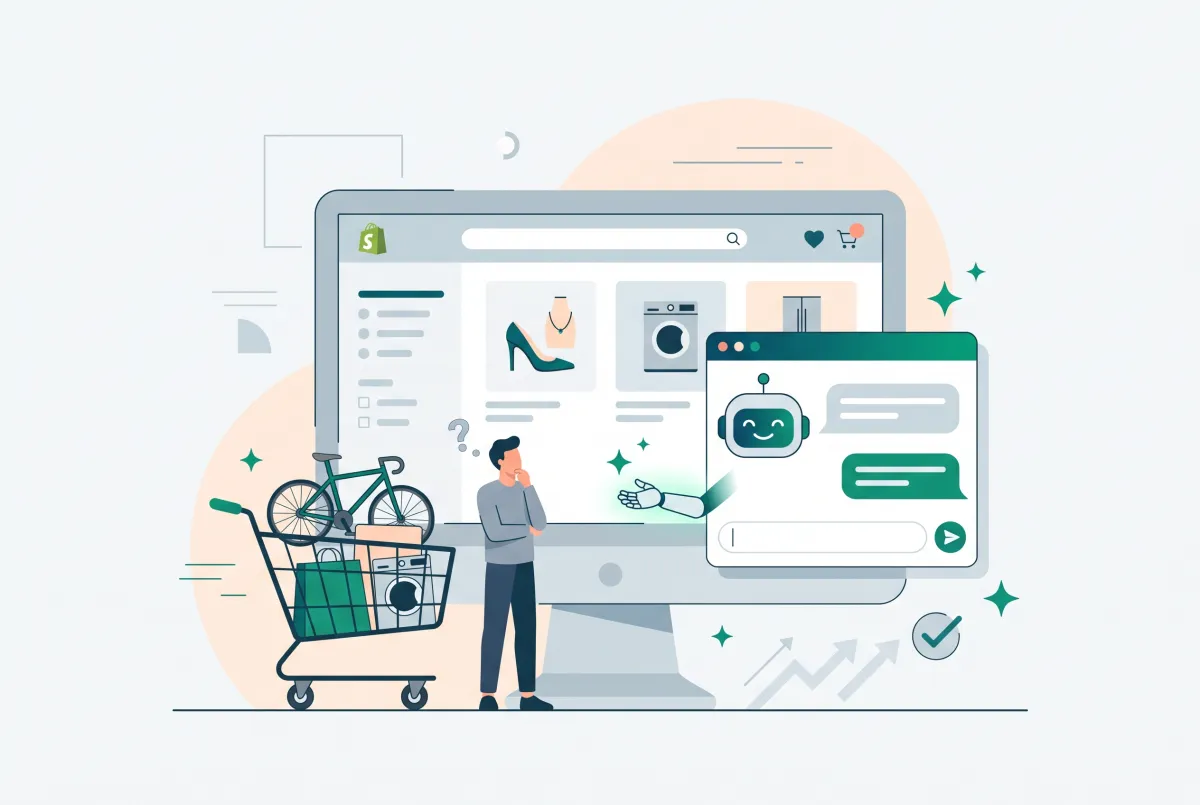
Why Do High-Ticket Shopify Stores Convert So Much Worse Than Everyone Else?
Because a big price tag buys hesitation, and hesitation is a question that never got answered. AI chat for high-ticket Shopify stores exists to close that gap, and the benchmark data shows exactly how wide it is: furniture stores convert at 1.41% of sessions, while luxury and jewelry sits at 0.94% against food and beverage at 6.22%.
That's a 6.6x spread between the best and worst verticals. It isn't a design problem or a traffic problem. It's a deliberation problem.
The cart data tells the same story from a different angle. Furniture carts abandon at 84% on desktop and 89% on mobile (Salesforce Research), well above the 70.19% all-ecommerce average tracked by Baymard. Yet furniture carries a $253 average order value, second only to luxury and jewelry. Small percentage gains here move real money.
And these buyers take their time. A single sofa purchase typically runs 14 to 21 days with four to six comparison visits before someone commits. Sixty-three percent of shoppers start online, but only 43% finish there. The other 20% leave with an unresolved doubt and either buy somewhere else or buy in a showroom.
Here's the part most merchants get wrong. They read a 1.4% conversion rate, assume the funnel is broken, and spend three months rebuilding the product page. The page is usually fine. The buyer just had one question it didn't answer.
What Does AI Chat for High-Ticket Shopify Stores Actually Replace?
It replaces the showroom sales associate, not the support ticket queue. On a $2,400 sectional or a $3,800 engagement ring, the person who closes the sale isn't processing a refund. They're standing next to the customer answering "will this fit through my door" and "is that stone actually certified."
That role has never existed online for most Shopify stores. You get a spec table, a size chart, and a contact form with a 24-hour reply window. A buyer deliberating for three weeks won't wait a day for a dimension.
The engagement numbers back the associate framing. Visitors who use live chat are 2.8x more likely to convert than silent browsers (ICMI), chat interactions produce a 10% increase in average order value (Forrester), and customers who chat before purchasing spend 60% more per order. Those lifts come from consultative conversation, not faster ticket resolution.
This is the distinction that matters. Support chat reacts to problems after the money changes hands. Sales chat removes doubt before it does. If you're running a high-consideration catalog and your chat widget only fires on the order status page, you've installed a help desk and called it a sales tool.
The mechanics of catching those pre-purchase questions overlap heavily with what we covered in recovering carts abandoned over unanswered questions, but the stakes scale with the price tag. Losing a $40 order to a vague shipping answer stings. Losing a $2,000 order to one costs you a month of margin.
Which Objections Actually Stall a High-Ticket Sale?
They cluster into four categories: fit, authenticity, compatibility, and aftercare. Each vertical phrases them differently, but every stalled high-ticket sale traces back to one of them.
Pull your chat transcripts and search console queries, and you'll see the same handful of questions repeat hundreds of times. Answer those well and you've done most of the work.
Furniture and Premium Home Goods
- Exact dimensions and clearance. Not just the product footprint, but whether an 88-inch sofa turns a 36-inch hallway corner or clears a 31-inch doorway.
- Material and durability. Performance fabric versus linen with two dogs and a toddler. Solid oak versus veneer at year five.
- Delivery timeline and method. Curbside drop or white glove? Eight weeks or in stock?
- Assembly. How many people, how long, what tools.
- Room fit. Nearly 67% of online shoppers feel uncertain about furniture they can't see or touch before buying it.
Jewelry and Watches
- Sizing. Ring size conversions, chain lengths on different frames, bracelet resizing options.
- Metal purity and hallmarking. What "14k solid" means versus gold-filled, and where the stamp sits.
- Certification. GIA or IGI report, lab-grown versus mined, whether the paperwork ships with the piece.
- Return policy on custom work. The single most common reason a personalized order stalls at checkout.
Electronics
- Compatibility. Does it work with the buyer's existing setup, OS version, port, or ecosystem?
- Spec comparison. How this model differs from the one they saw at a competitor for $180 less.
- Warranty terms. Length, what voids it, and how a claim actually gets filed.
Appliances
- Installation requirements. Voltage, dedicated circuit, water line, venting, door swing.
- Capacity versus space. Cubic feet against the cabinet cutout they already have.
- Energy rating and running cost.
- Service coverage. Who repairs it and whether a technician covers their zip code.
None of these are support questions. Every one is a sales objection, and every one has a factual answer sitting somewhere in your product data.
Why Does a Generic Chatbot Cost You More Than It Saves on a $2,000 Order?
Because a wrong or vague answer on a high-ticket item doesn't just lose the sale, it destroys the trust the buyer spent three weeks building. A scripted bot that replies "please contact our team for exact dimensions" is worse than no bot at all. It confirms the doubt and adds friction.
Generic chatbots fail high-consideration catalogs in three predictable ways: they answer from a keyword-matched FAQ that never anticipated the actual question, they hallucinate specifications when the answer isn't in their training data, and they can't reference the specific variant the shopper is actually looking at.
What you need instead is chat grounded in your real store data: the product record, the metafields, the shipping policy page, the warranty terms. When a shopper asks about the 92-inch version in walnut, the answer should come from that variant, not from a paraphrase of your homepage copy.
Grounding is the whole ballgame on expensive products. A confident wrong answer about ring sizing costs you a $3,000 order and a return shipping label.
This is the exact gap RagChat: AI Chatbot & Livechat was built for. It answers from your actual products, collections, and store pages rather than a scripted flow, surfaces matching items as product cards inside the conversation, and hands off to a human inbox when a question needs judgment. The free plan covers unlimited AI replies for up to 200 products, which is enough for most high-ticket catalogs, since a furniture or jewelry brand usually sells depth rather than SKU count. It's worth a look alongside whatever else you're evaluating.
How Do You Feed AI Chat the Data It Needs to Sell Big-Ticket Items?
Structure the answers before you install anything. An AI chat tool is only as accurate as the product data behind it, and most high-ticket stores keep their best selling information trapped in image files and PDF spec sheets where no system can read it.
Start with metafields. Shopify's metafields documentation uses a furniture store as its own example: create a Dimensions metafield and display width, height, and depth per product instead of burying them in the description. Do the same for material composition, assembly requirements, warranty length, certification numbers, and installation specs.
Then handle the four things that never live on a product page:
- Delivery detail by method and region. Curbside versus in-home, lead times per collection, which zip codes get white glove.
- Return terms by product type. Custom and personalized items almost always differ, and buyers know it.
- Care and longevity guidance. The durability answer that decides between your $2,000 piece and a $700 alternative.
- Comparison logic between your own models. Why the premium tier costs 40% more, in plain language.
If your catalog has heavy variant depth, the structuring work in our guide to running AI product Q&A on complex catalogs applies directly here. And because fit questions and return causes are closely related, cleaning up that data doubles as return prevention before the order ships.
When Should the AI Hand Off to a Human on a High-Ticket Order?
Hand off the moment the conversation shifts from information to negotiation. Specs, policies, compatibility, and sizing are AI work. Custom quotes, trade pricing, damage claims, and any buyer explicitly asking for a person are not.
Set three hard triggers: a request for pricing outside your published rates, any mention of a bespoke or made-to-order configuration, and repeated rephrasing of the same question, which is a reliable sign the answer isn't landing.
The handoff should carry the full transcript. Your sales rep picking up a $4,000 conversation cold, with no context, undoes the momentum the AI just built. Most tools support a shared inbox where AI and human replies live in one thread, which is the setup you want.
Offline hours matter more than merchants expect on high-ticket goods. Evening browsing is when people measure their living rooms. If you're building this from scratch, our live chat and AI support setup checklist covers the routing rules in order.
How Do You Measure Whether AI Chat Is Closing High-Ticket Sales?
Not with same-session conversion rate. That metric is built for impulse purchases, and it will make a well-performing chat tool on a furniture store look like a failure.
Track these instead:
- Assisted conversion over 30 days. Buyers who chatted at least once, then purchased within a month. Given the 14 to 21 day sofa decision cycle, anything shorter undercounts badly.
- AOV of chat sessions versus non-chat sessions. Benchmark against the 10% Forrester lift. High-ticket categories often exceed it because chat surfaces the upgrade tier.
- Objection resolution rate. The share of conversations that end with a satisfactory answer instead of a fallback or an unanswered question.
- Return rate on chat-assisted orders. If fit questions are being answered accurately, this drops.
- Unanswerable questions by frequency. Your product data roadmap, ranked.
That last one is the most valuable output and almost nobody uses it. Every question the AI couldn't answer is a gap in your merchandising, and the transcripts double as demand research, as we covered in what chatbot logs reveal about product demand.
Keep the ceiling realistic. McKinsey's research (cited in the same Baymard-sourced analysis above) puts the upside of personalized real-time engagement at up to a 40% conversion increase in digital commerce. You're not going to convert at 6%. Moving from 1.4% to 1.9% on a $253 average order is a 35% revenue increase, and on high-ticket goods that gap is the difference between a business that scales and one that stalls.

RagChat: AI Chatbot & Livechat
SponsoredAI chat that answers from your real products. Unlimited AI replies on the free plan.
Related Articles
Shoppers with sizing, spec, or fit questions bounce without answers. See how AI product Q&A chat lifts Shopify conversion rates on complex catalogs now.
Most Shopify cart abandonment isn't price shock, it's an unanswered question. See how real-time AI chat answers objections before shoppers leave.

Sizing, fit, and spec questions no one answered drive most returns. Learn how to reduce Shopify product returns with AI chat before an order ever ships.
AI Chatbot for Shopify: How to Automate Customer Support and Increase Sales
Learn how an AI chatbot for Shopify automates customer support, recovers abandoned carts, and boosts sales with 24/7 replies and smart product upsells.
What Your Shopify Chatbot Logs Reveal About Product Demand (And How to Use That Data)
Your Shopify chatbot logs are a market research goldmine. Learn how to read chat transcripts for real product demand signals and smarter roadmap calls.

How Product Reviews Increase Shopify Conversion Rates (And How to Get More of Them)
Product reviews can lift Shopify conversion rates by up to 380%. Learn how reviews, photos, and UGC turn browsers into buyers, with data to back it up.