
Multilingual Shopify Customer Support: How AI Chat Serves International Customers Without Hiring Translators
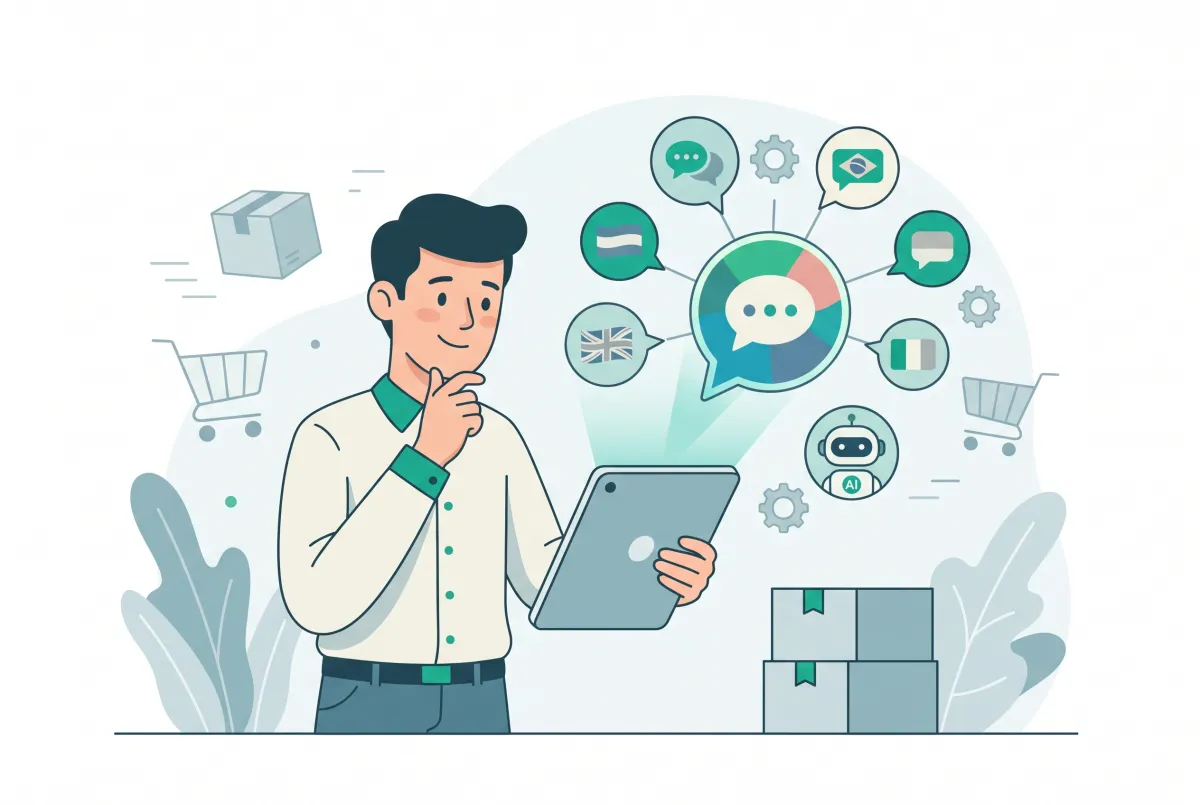
Your Shopify store shows prices in euros, your product pages read cleanly in German, and your checkout is fully localized. Then a shopper in Munich types a question into your chat widget, and the whole illusion falls apart. Multilingual Shopify customer support is the piece almost every international expansion plan skips, and it's the piece that decides whether the sale actually closes.
Shopify Markets handles the storefront. It does not handle conversations.
That gap is where international revenue quietly dies. The fix isn't hiring a translator, a Spanish-speaking VA, or a night-shift agent in Tokyo. It's chat that reads a shopper's language and answers from your real product catalog, for roughly the price of a takeaway lunch per month. Here's how it works, what it costs compared to hiring, and how to decide which languages to cover first.
Why Do International Shoppers Abandon Shopify Stores That Don't Speak Their Language?
Because browsing a product page in a second language is tolerable, but asking a question in one is not. CSA Research surveyed 8,709 consumers across 29 countries and found that 76% prefer to buy products with information in their own language, and 40% will never buy from websites in other languages.
That second number is the brutal one. It isn't a preference, it's a hard stop for two out of five potential customers.
The same body of research goes further on support specifically. CSA found 75% of shoppers are more likely to buy again from the same brand if customer care is available in their language. An earlier CSA study of 3,002 shoppers across 10 non-Anglophone countries found 60% rarely or never buy from English-only websites, split evenly between 30% who never do and 30% who rarely do.
Now layer that on top of normal ecommerce friction. Baymard Institute puts the average documented cart abandonment rate at 70.22%, based on 50 separate studies. Every unanswered question stacks on that baseline, and a question a shopper can't even phrase in your language never gets asked at all. It just becomes a closed tab.
This is the same mechanism behind ordinary abandonment, only harder to see in your analytics. We covered the general version in our guide to how AI chat recovers Shopify sales lost to unanswered questions. The international version is worse because the shopper won't email you afterward either. They'll go somewhere that already speaks their language.
What makes this so easy to miss is that your funnel looks fine. Traffic from France is up, sessions look healthy, and there's no support ticket volume from French customers to alarm you. The absence of tickets isn't a good sign. It's the symptom.
What Does Shopify Markets Actually Cover, and What Doesn't It Cover for Support?
Shopify Markets covers storefront localization: currency, catalogs and pricing per region, domains and subfolders, duties and import taxes, theme customizations per market, and published translations. It covers exactly zero words of a support conversation.
That distinction matters more than most merchants realize. Per Shopify's own documentation, every plan except Lite lets you sell in up to 20 languages from a single store. You add them under Settings > Languages, then assign them to specific markets under Markets > [your market] > Languages and domains. The free Translate & Adapt app handles product titles, descriptions, URL handles and theme content.
All of that is storefront output. It's one-directional. Shopify writes to the shopper, and the shopper reads.
The moment the direction reverses, Shopify's localization stack has nothing for you. A German shopper typing "passt das Armband an ein Handgelenk von 15 cm?" into your chat widget is having a conversation, not reading a page. Markets doesn't translate that message, doesn't translate your reply, and doesn't route it anywhere useful.
Here's the uncomfortable opinion: Shopify Markets gives merchants a false sense of security about going international. A store that looks multilingual but only supports in English is arguably worse than one that's honest about being English-only, because it sets an expectation it can't keep at the exact moment that decides the sale.
Think about what that shopper experiences. Localized domain, native-language product page, prices in euros, and then a chat widget that replies in English or, worse, doesn't reply for fourteen hours. You've spent the whole funnel building credibility and then spent it all in one message.
The same applies to your other support channels. Contact form auto-responders, order confirmation follow-ups, and post-purchase emails are usually English-only by default too. Markets won't touch any of them.
Hiring Multilingual Support Staff vs. AI Chat: What's the Real Cost Difference?
A single bilingual support hire in the US averages $52,393 per year, roughly $25 per hour, according to Glassdoor data from 1,445 submitted salaries. AI chat apps built for Shopify start free and top out around $39 per month.
Most cost comparisons on this topic are written for enterprise buyers with six-figure support budgets. That's not the situation most Shopify merchants are in. So let's do the small-merchant math instead.
Say you don't hire full-time. You bring on one part-time person for 15 hours a week at that same $25 per hour rate. That's about $19,500 a year before payroll taxes, tools, onboarding, or the time you spend managing them. And here's what that money buys you:
- One language. Not four. If your traffic is split across German, French, Spanish and Japanese, you've solved a quarter of the problem.
- One time zone. Fifteen hours a week means roughly 9% coverage of the week. International shoppers browse while you sleep.
- No product expertise on day one. They still have to learn your catalog, your sizing quirks, your shipping rules.
- Single point of failure. Holidays, illness, and resignation all take your entire multilingual capability offline.
Compare that to a chat app subscription. RagChat, for example, runs unlimited AI replies on its free plan with the assistant learning up to 200 products, your collections and your policies. Paid tiers are $14 a month for 1,000 products and $39 a month for 5,000 products with unlimited knowledge sources. That's the entire annual cost of the $39 plan coming in under $500, against $19,500 for part-time human coverage of one language.
This isn't an argument that AI replaces people. It's an argument about sequencing. Nobody selling into six countries at $40k a month in revenue should hire a translator before they've automated the 80% of questions that are repetitive: sizing, stock, shipping times, return windows, material composition.
We went deeper on this economics question in our breakdown of how solo Shopify founders handle customer support without hiring. The logic holds even harder internationally, because the human option gets more expensive with every language you add while the software option doesn't.
How Does AI Chat Automatically Detect and Respond in a Shopper's Language?
Modern AI chat widgets read language from three signals: the browser's language setting, the storefront language the visitor is currently viewing through Shopify Markets, and the language of the message the shopper actually types. The third signal overrides the other two, because what someone types is the most reliable statement of what they want to read.
That last point sounds obvious but it's where a lot of setups get it wrong. A German expat living in Amsterdam might have a Dutch IP address, an English browser, and type in German. Geolocation-based language switching would get that person wrong twice.
Detection at the message level solves it. The shopper writes in Portuguese, the reply comes back in Portuguese, and nobody has to click a flag icon in a dropdown. If they switch to English mid-conversation, the reply follows them.
Underneath, the sequence looks like this:
- Detect. The incoming message is classified by language.
- Retrieve. The system searches your product catalog, collections and policy pages for the relevant facts. This step is language-agnostic. The data lives in whatever language you wrote it.
- Generate. The answer is written using only those retrieved facts, in the shopper's detected language.
- Escalate if unsure. If confidence is low, the conversation goes to a human instead of guessing.
Step 2 is the one that separates a genuinely useful multilingual assistant from a translation gimmick, and it's the subject of the next section.
There's a compounding benefit here that gets overlooked. Language detection also delivers coverage across time zones for free, because software doesn't have working hours. A shopper in Seoul at 3am gets the same answer quality as one in Berlin at noon. We unpacked that side of the equation in our piece on covering every time zone without a 24/7 support team, and the two problems really are one problem: your international shoppers are awake and asking questions in a language you don't read, at an hour you're not working.
Can AI Chat Give Accurate Product Answers in Every Language, Not Just Translate Words?
Only if the answers are grounded in your actual catalog data rather than generated from the model's general knowledge. A general-purpose chatbot translating on the fly can produce a fluent, confident, completely wrong answer about stock levels or sizing, and you'd never catch it because you can't read the language it was wrong in.
This is the risk nobody writing about multilingual chat wants to talk about, and it's the one that should worry you most.
Hallucination in ecommerce support looks like invented discount codes, fabricated stock availability, and made-up return policies. Analysis of hallucination-free AI in ecommerce identifies retrieval-augmented generation, where every response is grounded in verified business documents, as the baseline fix, with additional layers on top: contextual boundaries restricting the AI to verified content, automated validation of responses against source material, and confidence scoring that escalates uncertain answers to a human.
Now add a language you can't audit. In English, a wrong answer eventually surfaces in a support ticket or a refund request and you trace it back. In Japanese, it surfaces as a chargeback three weeks later with no obvious cause.
Retrieval-augmented generation (RAG) is what makes multilingual answers trustworthy. The AI doesn't recall what a typical bracelet's clasp is like.
It looks up your specific product's description, variants and metafields, then writes the answer from that. Your inventory data and your product copy don't change meaning across languages. Only the phrasing does.
This is precisely what RagChat is built around: the assistant learns from your real products, collections and store pages rather than answering from open-ended model knowledge, and it offers real-time translation on top of that grounded layer. The ordering matters. Grounding first, translation second. Do it the other way round and you've built a very articulate liar.
The accuracy problem gets sharper the more complex your catalog is. If you sell one product in three colors, almost any chatbot will cope. If you sell 2,000 SKUs with technical specs, compatibility rules and size charts, retrieval quality is the entire product. Our guide to AI product Q&A chat on complex catalogs covers how that retrieval layer should be structured.
One practical test before you commit to any tool: ask it a question in a second language about a product detail that only exists in your catalog, something like a specific variant's weight or a material blend. If it answers correctly, retrieval is working. If it answers plausibly but wrong, you've just learned something important for free.
How Do You Set Up Multilingual Shopify Customer Support With AI Chat?
The setup is four steps and takes under an hour on most stores. Install a chat app that supports catalog grounding, let it index your products and policies, enable language detection, and configure the escalation path for questions it can't confidently answer.
Here's the sequence in practice.
1. Get your storefront translations in order first. If your German product descriptions are machine-translated garbage, your AI will retrieve garbage and answer in garbage. Use Shopify's Translate & Adapt app or a dedicated translation app, then review the top 20 products by revenue manually. This is the single highest-leverage hour in the whole process.
2. Install and index. Add the chat app from the Shopify App Store and let it crawl your catalog, collections, and policy pages. Confirm it picked up shipping, returns and sizing pages specifically, because those generate the majority of pre-purchase questions in any language.
3. Turn on language detection and test it properly. Don't just check that it works. Open your store in an incognito window, switch to a market with a different language, and ask a real product question in that language.
Then ask a follow-up. Then switch languages mid-conversation.
4. Configure escalation before you go live. This is the step everyone skips.
What Should Happen When the AI Can't Answer in a Given Language?
It should stop, say so plainly in the shopper's language, capture their email, and hand the thread to a human. Silence and guessing are both worse than an honest "I'll get someone to confirm that for you."
Set your handoff rules explicitly. Any question touching custom orders, warranty claims, damaged goods, or anything with a legal or financial dimension should route to a person regardless of confidence score. Same for repeat questions in one session, which usually signal the shopper isn't getting what they need.
The mechanism matters as much as the rule. A shared inbox where AI and human conversations sit together means you can pick up a Japanese thread, paste it into a translator yourself, and reply, without the customer needing to start over. RagChat handles this with a shared human and AI inbox plus email follow-ups for offline questions, so a conversation that starts at 2am in Osaka doesn't just evaporate when the AI hits its limit.
If you're building this from scratch on a newer store, our live chat and AI customer support setup checklist walks through the base configuration that applies before you add languages on top.
Which Languages Should You Support First, and How Do You Know?
Use three data sources you already have: your Shopify Markets and analytics country breakdown, your GA4 country and language reports, and your existing chat and email logs. Rank by revenue potential, not by traffic volume, because those two rankings are almost never the same.
Here's a framework that takes about 30 minutes.
Step 1: Pull sessions and revenue by country from Shopify. In your Shopify admin, look at Analytics > Reports > Sessions by location alongside Sales by location. Write down the top eight countries for each. The countries with high sessions and disproportionately low sales are your best candidates, because that gap is often a language and trust problem rather than a demand problem.
Step 2: Cross-reference GA4's language dimension. Country tells you where someone is. Google Analytics 4's user-scoped Language dimension tells you what their device is set to, which is a much better proxy for what they want to read.
Build an exploration with Country and Language as rows and sessions plus purchase rate as metrics. Switzerland splitting into German, French and Italian is the kind of insight this surfaces that country data alone hides.
Step 3: Read your existing chat and contact form logs. Sort by language. If you're already getting messages in Spanish that you've been answering slowly through a translation tab, that's demand you've measured without noticing. Your support logs are underrated as a demand signal generally, which we wrote about in what your Shopify chatbot logs reveal about product demand.
Then apply one filter to your shortlist: can you fulfil orders there profitably today? A language you can't ship to affordably is a language that generates support volume and no revenue. Shipping economics should veto a language before language data promotes it.
Start with two languages beyond English. Not six. Two languages done well, with reviewed translations and tested chat answers, will outperform six done automatically, and you'll actually be able to spot-check the quality.
Does Native-Language AI Support Actually Move the Needle on Conversion?
The directional evidence is strong, and the market timing makes it hard to ignore. Analysis of cross-border ecommerce trends projects that AI-powered localization tools will improve cross-border conversion rates by up to 30% over the next five years, and the same research notes roughly 62% of shoppers expect localized pricing in their own currency.
Localization compounds. Currency alone helps. Currency plus translated pages helps more. Currency, translated pages, and a chat that answers accurately in the shopper's language is where the friction actually disappears.
The market context is worth understanding too. Coherent Market Insights values cross-border ecommerce at $1.74 trillion in 2026, projected to reach $4.85 trillion by 2033 at an 18.6% compound annual growth rate. That's not a niche you're optionally exploring. It's where a growing share of ecommerce demand already lives.
Shopify's own numbers point the same direction. International GMV grew 41% year over year in Q3 2025, with Europe up 49% and now accounting for 21% of Shopify's total revenue, up from under 18% two years earlier. Merchants are already selling internationally. Most of them just aren't supporting internationally.
What to actually measure once you've turned it on, over a 60 to 90 day window:
- Conversion rate by market, before and after, not blended across all traffic
- Chat engagement rate by language, since a widget nobody in France opens tells you something
- Resolution rate without human escalation, split by language
- Refund and return rate by market, because bad answers in languages you can't audit surface here first
That fourth metric is the honest one. If returns from a specific market spike after you enable AI chat there, your retrieval or your translations are wrong, and you'd rather know in month two than month twelve.
None of this requires a support team, a translation agency, or a localization consultant. It requires accepting that Shopify Markets solved half the problem and stopped, and that the unsolved half is the conversation, which is the part that closes sales.
If you're still deciding whether automated support fits your store at all, start with the fundamentals in our guide to using an AI chatbot on Shopify to automate customer support, then layer languages on top once the English version is answering accurately. Get the grounding right first. Everything else is translation.

RagChat: AI Chatbot & Livechat
SponsoredAI chat that answers from your real products. Unlimited AI replies on the free plan.
Related Articles
AI Chat for Global Shopify Brands: Covering Every Time Zone Without a 24/7 Support Team
Selling to EU, APAC, or global customers on Shopify? See how AI chat covers every time zone without hiring night shifts, overseas staff, or missing sales.
AI Chatbot for Shopify: How to Automate Customer Support and Increase Sales
Learn how an AI chatbot for Shopify automates customer support, recovers abandoned carts, and boosts sales with 24/7 replies and smart product upsells.
How to Set Up Live Chat and AI Customer Support for a New Shopify Store (2026 Checklist)
Learn how to set up live chat and AI customer support for a new Shopify store, step by step, with the best AI app to automate support around the clock.
AI chat support for solo Shopify founders handles repetitive questions 24/7, so you can skip hiring, dodge burnout, and keep sounding like yourself daily.
Shoppers with sizing, spec, or fit questions bounce without answers. See how AI product Q&A chat lifts Shopify conversion rates on complex catalogs now.
WISMO tickets can eat up to 50% of a growing Shopify store's support inbox. See how AI chat connected to real order data auto-answers them 24/7, for free.