
How to Import Reviews from Amazon to Shopify (3 Methods That Work)

If your best Amazon listings already carry dozens of buyer reviews, launching Shopify with empty product pages throws away proof shoppers expect. You can still import Amazon reviews to Shopify, but Amazon is not a simple URL-paste job anymore. CAPTCHA blocks most paste flows, so the reliable paths are a Chrome extension, a careful CSV, or a paid importer that names Amazon on its listing.
This page is Amazon-only. Shop App merchants can follow our Shop App review import walkthrough. For a wider marketplace map, see our roundup on importing reviews from Amazon, AliExpress, and more. The steps below follow the same one-job pattern as our Shopee review import walkthrough, with Amazon-specific CAPTCHA and plan limits called out.
Why Should You Import Amazon Reviews When Opening Shopify?
Imported Amazon reviews give Shopify hero SKUs day-one social proof so shoppers do not bounce to empty ratings. Northwestern's Spiegel Research Center found that products with five reviews have a 270% greater purchase likelihood than products with none.
The same Spiegel work reported conversion lifts of about 190% for lower-priced products and 380% for higher-priced ones when reviews were displayed, with purchase likelihood peaking between 4.0 and 4.7 stars. Amazon catalogs often skew mid-to-high ticket, so blank Shopify pages hurt more, not less.
BrightLocal's Local Consumer Review Survey 2026 found that 97% of consumers read reviews for local businesses, and 93% have made a purchase after reading reviews. Bazaarvoice also reports that 10 product reviews can lift conversion by 45%. You do not need the full Amazon long tail on day one. You need authentic ratings on the SKUs shoppers hit first.
Most Amazon sellers are not quitting Seller Central overnight. They add Shopify for brand control, owned email lists, and checkout that is not locked inside Amazon. That dual-channel move only works if Shopify looks credible next to your Amazon listing. If you are also moving catalog data, pair this guide with our Amazon to Shopify product migration walkthrough.
Imported reviews also buy you time. Organic Shopify review collection takes weeks. A seeded product page lets paid traffic and email launches start without waiting for the first ten Shopify buyers to leave feedback.
Can You Export Reviews from Amazon Seller Central?
No. Amazon Seller Central does not give you a clean "Download product reviews CSV" for buyer text, photos, and star ratings the way some order reports work. Feedback tools and Business Reports cover other seller metrics. Product review content stays on the Amazon product detail page.
That is normal marketplace design. Amazon benefits when social proof stays on Amazon. Your practical options are a Shopify review app with an Amazon Chrome extension, a spreadsheet you build yourself, or a paid importer that lists Amazon under Works with.
Guides that still tell you to paste an Amazon URL into an AliExpress-style importer are out of date. Amazon, Shopee, Shein, and Temu are CAPTCHA-protected on many review apps. Treat URL paste as a dead end for Amazon unless the app docs say otherwise.
If you only need a broader map of marketplace imports after you finish Amazon, return to the multi-platform roundup linked above. Keep this page for the Amazon CAPTCHA path so you do not mix AliExpress paste advice into an Amazon job.
Which Shopify Apps Support Amazon Review Imports?
Fewer free apps support Amazon than AliExpress. Before you install anything, open the Shopify App Store listing and confirm Amazon is named under Works with or supported sources.
WiseReviews lists Amazon among supported sources (AliExpress, Amazon, CJdropshipping, eBay, Etsy, HKTVMall, Lazada, Shein, Shop App, Shopee, Temu, Tokopedia, Wish). As of September 2026, Free is $0 for up to 100 published reviews held at a time, plus a lifetime 300 marketplace URL and Chrome extension import allowance (deletes do not refund that 300). Standard is $9.95/month for up to 50,000 reviews with auto-sync, and Plus is $19.95/month for unlimited reviews plus bulk multi-URL import. The listing sits at 4.8 stars from 162 reviews. Amazon needs the Chrome extension import path, not a plain URL paste. See also the WiseReviews importing-reviews docs.
Areviews works with Amazon, but Free is AliExpress only. Amazon needs Premium at $6.99/month. Ultimate is $12.99/month for auto-sync. The listing sits at 4.8 stars from 224 reviews. That paid Amazon path is method three when you already prefer Areviews or need its workflow.
Trustoo Ali Reviews Importer is free and lists AliExpress, Shopee, DSers, and Etsy. It does not list Amazon. Do not install it expecting Amazon coverage.
When you compare listings, look for three Amazon signals: the word Amazon in Works with, whether CAPTCHA sources need a browser extension, and whether free tiers exclude Amazon. Pricing should follow catalog size. Free's 100-held published cap and lifetime 300 marketplace/extension imports can prove the workflow. Past that, paid plans matter for auto-sync and higher caps.
For a broader widget and pricing comparison across Judge.me, Loox, Yotpo, and Okendo, see our Shopify review apps comparison. That piece is about display apps. This page is about getting Amazon reviews onto Shopify in the first place.
Hot take: Amazon URL paste that worked last year often fails now because of CAPTCHA. The extension path is the real method. If a 2024 guide still shows "paste the Amazon link and wait," treat it as outdated.
How Do You Import Amazon Reviews to Shopify with a Chrome Extension?
Install the review app, connect its Chrome extension, open the Amazon product page, and import into the matching Shopify product. This is the primary method for CAPTCHA-protected Amazon listings, and the one most Amazon sellers should try first.
With WiseReviews, the flow follows the extension docs:
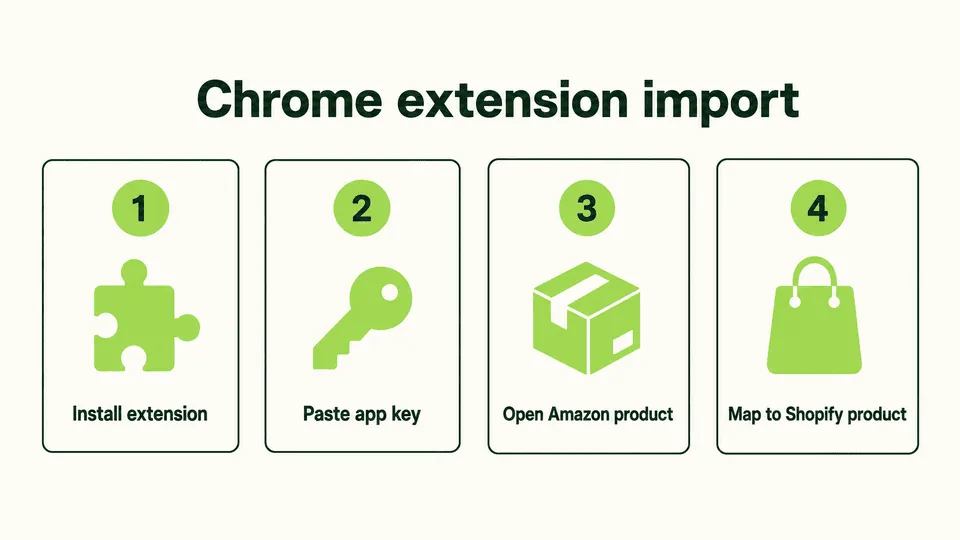
- Install WiseReviews from the Shopify App Store and open the app in your admin.
- Open the Extension page inside WiseReviews, then install the extension from the Chrome Web Store (extension id ahpjhlgbnkhnnmlelpkjnlijkibhdhkg).
- Connect the Extension app key so the browser tool can talk to your store.
- Open the Amazon product detail page that matches a product you sell on Shopify.
- Use the extension to select reviews, map them to the Shopify product, set filters if needed, and import.
Budget a few minutes per product on the first pass while you learn filters and name display settings. After that, the mapping pattern repeats. On WiseReviews Free you can hold up to 100 published reviews at a time, and marketplace URL plus Chrome extension imports share a lifetime 300 allowance that deletes do not refund—enough to seed top sellers. Standard adds auto-sync up to 50,000 reviews. Plus removes the review cap and adds bulk multi-URL workflows for larger catalogs.
If the extension fails to detect reviews, confirm you are on a product detail page (not a search result), you are logged into a normal browser session that can load Amazon, and the extension key is still connected. CAPTCHA challenges are why this path exists. Do not keep retrying a dead URL paste flow.
Work product by product for the first session. Import your top sellers, publish, check the storefront theme, then continue. Rushing fifty ASINs before you verify widgets is how stores end up with reviews on the wrong handles.
How Do You Import Amazon Reviews with a CSV File?
Yes. Build a spreadsheet and upload it into any Shopify review app that accepts CSV imports. This is slower, but it works when you want a curated set, translations, or a mix of sources in one file.
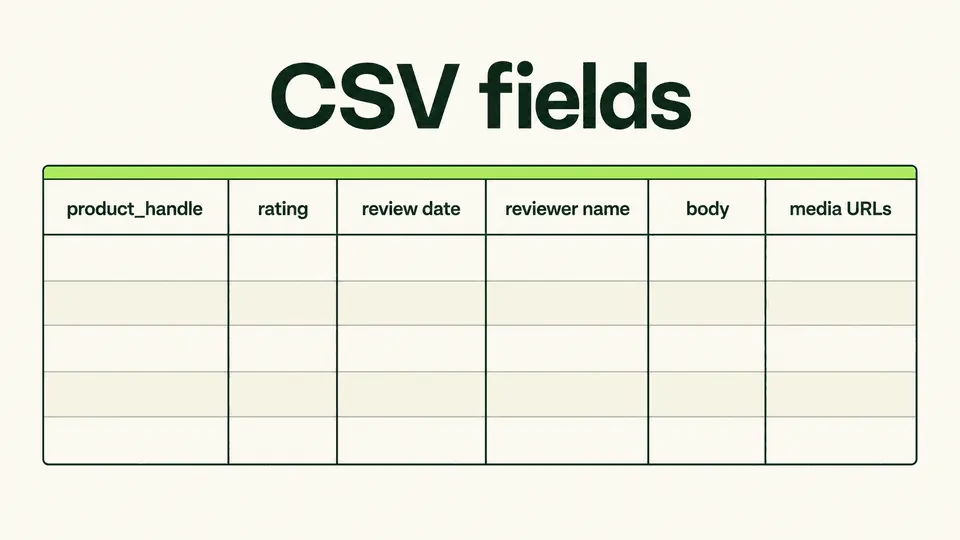
In WiseReviews, CSV import lives under Reviews, then More actions, then Import via CSV. Required fields include:
- product handle: the Shopify product slug from the product URL
- rating: a number from 1 to 5
- review date: when the buyer left the review
- reviewer name: display name as you want it shown
Keep each file at or under 3,000 rows. Product handle must match a real product in your store or the row fails. Optional columns such as review body, title, and media URLs are useful when your template supports them.
A practical Amazon CSV workflow:
- Open each Amazon product page you care about and copy reviewer name, star rating, date, and review text into a sheet.
- Add the matching Shopify product handle for every row.
- Strip Amazon-only shipping or Prime praise that will confuse Shopify shoppers, or hide those rows after import.
- Upload the CSV, map columns, spot-check one product page, then publish.
If you have more than roughly fifty reviews to move by hand, stop and switch to the Chrome extension. Manual entry error rates climb once you are tired, and one wrong product handle publishes reviews on the wrong SKU.
CSV is the right method when you want surgical control: only 4- and 5-star reviews, only photo reviews, or only English text for an English storefront. It is the wrong method if you have hundreds of reviews per ASIN and no time to copy them. CSV is also the fallback when an extension cannot load a regional Amazon domain, when you need to merge Amazon reviews with another channel, or when your team wants a spreadsheet audit trail before anything goes live.
The same CSV mindset shows up in our AliExpress review import walkthrough, with different source quirks.
How Do You Import Amazon Reviews with a Paid Amazon Importer App?
Use a Shopify app that lists Amazon under Works with and accept that Amazon is often locked behind a paid plan. Areviews is the clearest example: Free is AliExpress only, so Amazon needs Premium at $6.99/month, with Ultimate at $12.99/month when you want auto-sync.
This is method three for sellers who already run Areviews, who need that app's Amazon workflow, or who hit a free-tier ceiling elsewhere. Install the app, upgrade to the Amazon-capable plan, then follow its Amazon import steps (extension or in-app flow, depending on the vendor). Confirm Amazon on the live Works-with list before you pay.
Do not treat "free review importer" as a synonym for Amazon support. Trustoo stays free for AliExpress, Shopee, DSers, and Etsy, but it does not list Amazon. Paying for the wrong app wastes a week. Paying for an app that names Amazon is usually cheaper than rebuilding trust from zero.
What Should You Do After You Import Amazon Reviews to Shopify?
Imported reviews only help if shoppers can see them, trust them, and keep adding new ones after launch. Treat the import as day-one seed data, not the whole review strategy.
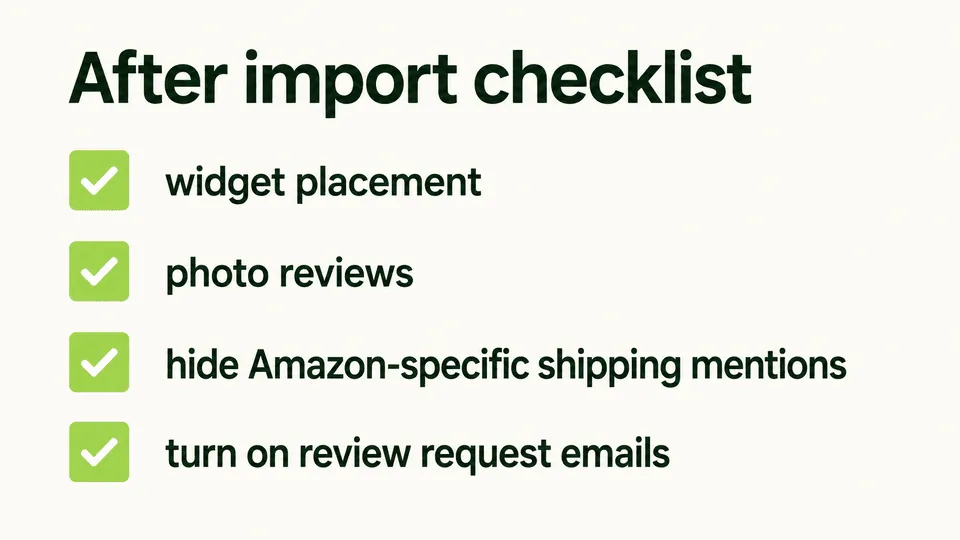
Do these post-import checks:
- Widget placement: put star summaries near the price and the full review block high enough on mobile that shoppers do not miss it.
- Photo priority: Bazaarvoice found that 60% of shoppers would rather buy a product with 10 reviews that include user images than 200 text-only reviews. Import media when the source has it. Our photo vs text reviews breakdown explains why visual proof wins.
- Marketplace leftovers: hide reviews that only praise Amazon Prime delivery, Amazon packaging, or voucher codes that do not exist on Shopify.
- Moderation: keep ratings honest. Do not delete every critical review. Shoppers distrust perfect 5.0 averages, and Spiegel's peak band sits between 4.0 and 4.7 stars.
- Request emails: turn on post-purchase review request emails so imported Amazon ratings are not your only source of truth.
Start with your top ten revenue SKUs, not the entire long tail. Shoppers hit bestsellers first, and that is where empty review sections cost the most. Once those pages convert, expand in weekly batches so moderation stays manageable.
If you want the conversion case in more depth, read how product reviews increase Shopify conversion rates. Measure the import like any other conversion change: compare add-to-cart and purchase rate on seeded products against unreviewed control SKUs for two weeks. If the lift is weak, fix widget placement and photo coverage before you buy a higher plan for bulk sync.
A hybrid launch works well for Amazon brands: keep Seller Central open, seed Shopify hero products, and shift paid traffic only after Shopify conversion looks healthy. Imported reviews are the bridge, not the permanent strategy.
What Legal and Ethical Rules Apply to Amazon Review Imports?
Import only reviews written about products you sell, keep the text and ratings unedited, and attribute reviewers honestly. Treat marketplace reviews as someone else's words you are republishing, not as content you own by default.
Practical rules that keep you out of trouble:
- Import reviews for your own products, not competitor ASINs you do not sell.
- Do not rewrite negative reviews or inflate star ratings.
- Do not invent "Verified buyer" badges for imported marketplace reviews unless your app and local law support that claim.
- Remove a review quickly if the original reviewer asks.
- Follow your review app's permission checkbox and Amazon's Conditions of Use for content reuse in your market.
Large-scale scraping of Amazon pages sits in a policy gray area under Amazon's terms. Keep risk lower by sticking to your own products and leaving the content intact. The FTC Consumer Reviews and Testimonials Rule (in effect since October 2024) targets fake, bought, and misleading reviews. Do not present imported marketplace reviews as if they were written by Shopify customers if your badges imply that. If you sell in the EU or handle regulated categories, talk to counsel before high-volume automation.
One sequencing tip: import reviews after products exist on Shopify, not before. Review apps need a real product handle or product picker target. Finish titles, images, and handles from your catalog move first, then run the review import so you do not remap everything twice.
Bottom line: Amazon will not hand you a tidy review export, and URL paste often fails under CAPTCHA. Use a Chrome extension on a capable review app, a careful CSV, or a paid Amazon importer that names Amazon on the listing. Seed your bestsellers, keep the text honest, then collect new Shopify reviews so the store does not depend on Amazon forever.

WiseReviews ‑ Reviews Importer
SponsoredImport Photo & Video Reviews from your favorite e-commerce platforms easily!
Related Articles
How to Import Reviews from Shopee to Shopify in 2026 (3 Methods)
Import reviews from Shopee to Shopify with a Chrome extension, CSV, or review app. Free options, CAPTCHA limits, and what data still transfers in 2026.

How to Import Reviews from AliExpress to Shopify (2026 Walkthrough)
Learn how to import reviews from AliExpress to Shopify the right way in 2026, with a video walkthrough, FTC compliance rules, and top import apps compared.

How to Migrate Product Reviews from Etsy to Shopify Without Losing Star Ratings
Star ratings vanish in most Etsy imports. Learn how to migrate product reviews from Etsy to Shopify with ratings, photos and rich snippets fully intact.

Learn how to import product reviews to Shopify from Amazon, AliExpress, Etsy, and more. Step-by-step guide with app recommendations and best practices.

How Product Reviews Increase Shopify Conversion Rates (And How to Get More of Them)
Product reviews can lift Shopify conversion rates by up to 380%. Learn how reviews, photos, and UGC turn browsers into buyers, with data to back it up.
Finding the best Shopify review apps? We compare Judge.me, Loox, Yotpo, Okendo, and Stamped on actual pricing, page speed, features, and hidden costs.