
How to Import Reviews from AliExpress to Shopify (2026 Walkthrough)

A brand new product page with zero reviews converts like an empty restaurant. That's why so many dropshippers and new store owners want to import reviews from AliExpress to Shopify before spending a single dollar on ads. The mechanics take about ten minutes. The part nearly every tutorial skips is whether the reviews you just imported are legal to display.
The ground shifted twice recently. Shopify pulled its own free Product Reviews app from the App Store on May 6, 2024, a change merchants are still working through in the community forums. Reviews now live in third-party apps or in Shopify's standard product review metaobject. At the same time, the FTC's Consumer Review and Testimonials Rule went live and, in December 2025, produced a round of warning letters to 10 companies.
So this walkthrough covers both halves: the methods that actually work in 2026, and the compliance rules that decide whether your imported reviews are an asset or a liability. If you want the broader multi-platform view first, our guide on importing product reviews to Shopify from Amazon, AliExpress and more covers the other source marketplaces. The video below walks through the entire AliExpress import end to end inside a live Shopify store.
Why Should You Import AliExpress Reviews to Your Shopify Store?
Because an empty review widget actively costs you sales, and AliExpress listings often hold thousands of reviews with real customer photos for the exact product you're reselling. Social proof is the cheapest conversion lever a new store has, and imported reviews fill the gap until first-party reviews arrive.
The numbers back this up. PowerReviews found that shoppers who interact with user-generated photos and videos on a product page convert at 6.5%, against a 3.2% site average, a 103.9% lift. Visual content is the part AliExpress does unusually well, since buyers there routinely upload unboxing photos.
There's a volume argument too. Dropshipping stores have grown from 5.16% to 12.82% of all Shopify stores, according to Analyzify's data. That means a lot of stores are launching with identical supplier catalogs and no purchase history, all competing for the same shopper who wants proof that the product isn't junk.
Imported reviews also do quiet work beyond the add-to-cart button. They add unique text to an otherwise duplicated supplier description, they answer objections you never thought to address, and they give you raw material for ad creative. We broke down that compounding effect in our piece on how product reviews increase Shopify conversion rates.
One honest caveat before you get excited. Imported reviews are a bridge, not a destination. They buy you credibility for the first sixty days while your own customers start leaving feedback, and any store still running purely on imported reviews a year later has a bigger problem than social proof.
Can You Still Scrape AliExpress Reviews in 2026? (What Makes It Harder Now)
You can, but building your own scraper is a bad use of your time, and the reason is technical rather than legal. AliExpress offers no public API for review data, so every tool that pulls reviews is working around defenses designed to stop exactly that.
A 2026 technical breakdown from Alterlab's AliExpress scraping guide documents the stack you're up against. It includes TLS/JA3 fingerprinting that blocks non-browser HTTP clients at the connection layer, browser fingerprinting via canvas rendering, WebGL parameters and font enumeration, behavioral signals like mouse movement and scroll velocity, IP reputation scoring that blocks datacenter ranges outright, and CAPTCHA escalation on anomalous access patterns.
The internal data gateway AliExpress uses (MTOP) isn't an open door either. The same source notes it requires valid session cookies, a cryptographically signed token parameter, and headers that precisely match a genuine browser fingerprint. Miss one, get nothing.
What this means in practice is simple. A scraper you build or buy off GitHub works for a week, then silently returns empty arrays after a fingerprinting update. Maintained apps absorb that maintenance cost because they have hundreds of stores sharing it. You don't.
To be clear about what I'm not saying: there is no publicly announced AliExpress policy that specifically banned review imports on a given date in 2026. The friction is engineering friction. That distinction matters because it tells you where the actual risk sits, and it isn't with AliExpress. It's with the FTC, which we'll get to.
How Do You Import Reviews from AliExpress to Shopify With WiseReviews?
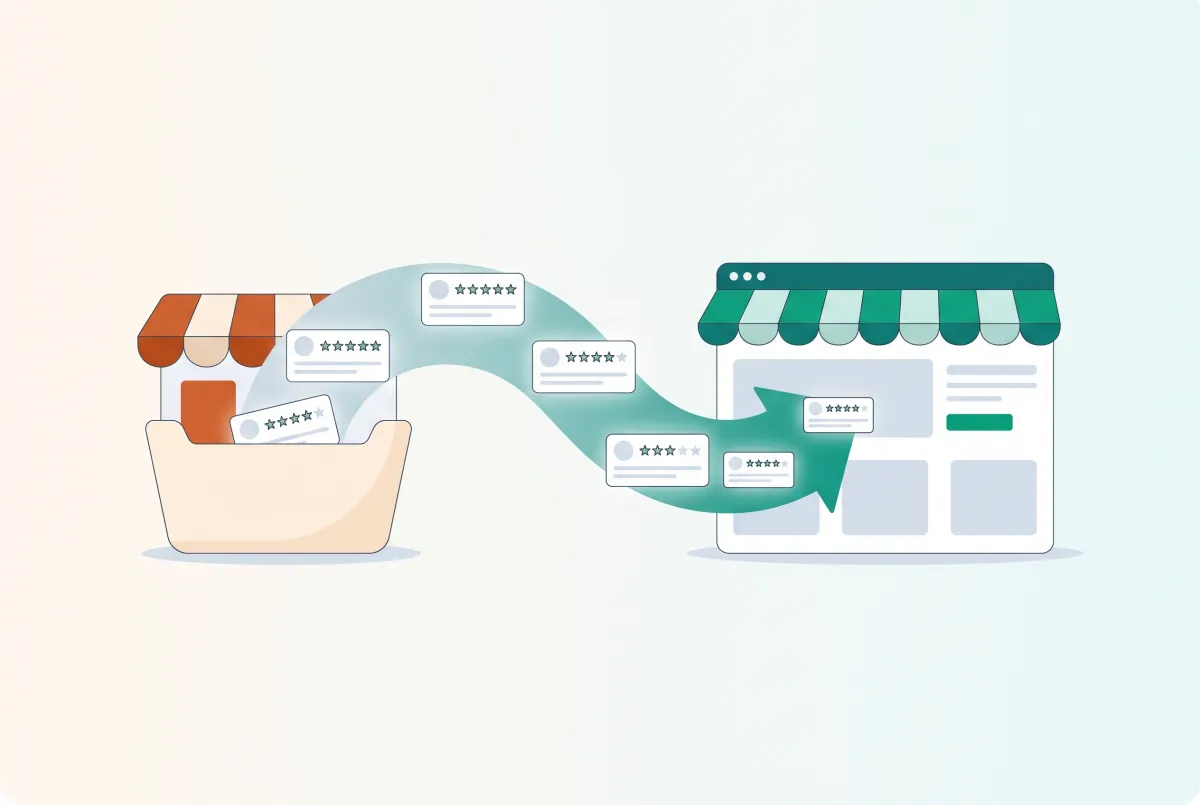
You install the app, pick the Shopify product you want reviews on, paste the AliExpress product URL, and let it pull the reviews with their photos, videos, star ratings and original dates. WiseReviews is the method shown in the video above, and it exists precisely because the two DIY alternatives (a scraper that breaks, or hand-building a CSV) both waste an afternoon.
Here's the sequence in order.
- Install the app and add its widget to your product template. Reviews that import successfully but never render are the most common wasted hour in this whole process. Confirm the widget block appears on a live product page before importing anything.
- Open the AliExpress listing for the exact product you sell. Not a similar one. Not the same item in a different colorway. The identical listing your supplier ships from.
- Copy the product URL and paste it into the importer, then map it to the matching Shopify product.
- Review what came back before publishing. Delete the ones that are pure emoji, obviously about a different variant, or machine-translated into nonsense.
- Publish, then check the product page on mobile. Photo reviews are heavier than text and mobile is where most of your traffic lands.
On features and cost, the listing confirms support for AliExpress alongside Amazon, Shopee, Lazada, Shein, Tokopedia, Etsy, Wish, HKTVMall, Temu, CJdropshipping and eBay. The free plan holds up to 100 published reviews at a time and includes a lifetime 300 marketplace URL and Chrome extension import allowance (deletes do not refund that 300). The Standard plan at $9.95/month covers up to 50,000 reviews and adds auto-sync for new reviews, and the Plus plan at $19.95/month adds batch URL imports for merchants doing many products at once. It currently sits at 4.8 stars across 151 reviews.
The batch import tier is the one worth understanding. If you're launching thirty products, doing them one URL at a time is the tedium that makes people give up halfway and leave half their catalog reviewless. The workflow is close to identical for other marketplaces, which we documented in our Etsy reviews import walkthrough if you source from more than one platform.
If you're still in the store setup phase and importing the products themselves as well as their reviews, Migratify handles the catalog migration side from 100+ platforms, which keeps product creation and review import as two clean steps instead of one messy one.
What Are the Best Alternatives? (Loox, Judge.me, Ali Reviews, and CSV Import Compared)
Four realistic options exist, and they differ mainly in how the import is triggered and what the app costs once you scale. Judge.me is the cheapest entry point, Loox uses a browser bookmarklet, Ali Reviews is purpose-built for dropshipping, and CSV import is the manual fallback that always works.
Judge.me
Judge.me runs a separate, free Ali Reviews Importer app rather than baking imports into the main app. You select a product, paste the AliExpress URL, apply filters for rating or photos, and import. Per Judge.me's own documentation, the older AliExpress Chrome extension is no longer supported and its login flow no longer works, so ignore any tutorial still recommending it. The core Judge.me app has a forever-free plan with unlimited review requests, and the Awesome plan runs $15/month. The importer itself carries the AliExpress photos across, which is the part that matters most.
Loox
Loox takes a different route. Its help documentation explains that you drag an "Import to Loox" button into your browser bookmarks bar, open the AliExpress product page, and click the bookmarklet while you're on it. Imported reviews then land in Manage Reviews. It works, though the bookmarklet approach means you're doing it one product page at a time in an open browser.
Ali Reviews by FireApps
Ali Reviews was built around this exact use case and pulls from AliExpress, Amazon, Temu, eBay and Etsy with one-click imports, plus migration tools for moving existing review libraries off Judge.me, Loox, Yotpo or Stamped. Pricing starts at $14.95/month, making it the priciest entry point of the four.
CSV Import
Every serious review app accepts a CSV. If a marketplace has no connector, you can assemble rows manually with reviewer name, rating, date, body text and image URL, then upload. It's slow and it's error-prone, but it's the only method nobody can deprecate on you. The same column-discipline rules from our guide on importing products to Shopify from a CSV without errors apply here, especially around date formats and encoding.
Picking between them comes down to two questions. How many products are you importing for, and do you need the reviews to keep syncing after the first pull? One-off imports across five products suit the free tiers fine. Thirty products with ongoing sync justifies paying for batch imports, because the alternative is an afternoon of pasting URLs that you will not enjoy.
For a wider look at how these apps compare on widget design, email requests and long-term cost rather than just imports, see our breakdown of the best Shopify review apps compared for 2026. And if AliExpress isn't your only supplier channel, our guide to importing reviews from Shopee to Shopify covers the Southeast Asian marketplaces that most importers handle differently.
Is It Legal to Import AliExpress Reviews? (FTC Rule, Disclosure, and Shopify Policy)
Importing itself isn't banned, and Shopify lists AliExpress review importer apps in its own App Store. What is banned is displaying reviews that misrepresent who wrote them or what product they were about, and that's where almost every store gets this wrong.
The FTC's Consumer Review and Testimonials Rule took effect on October 21, 2024. The final rule announcement prohibits fake reviews, reviews attributed to people who don't exist, and reviews from anyone who didn't have actual experience with the product. Read that last clause slowly, because it's the one that catches imported reviews for the wrong product.
This is no longer theoretical. On December 22, 2025, the FTC sent warning letters to 10 companies over suspected violations of the rule. The letters aren't formal determinations that anyone broke the law. They do remind recipients that violations can trigger a federal lawsuit and civil penalties of up to $53,088 per violation. Per violation, not per store.
Most "import AliExpress reviews" guides treat this as a growth hack: paste a URL, get 500 five-star reviews, done. None of them mention that the FTC can now fine you per violation for displaying reviews that misrepresent who wrote them or what product they described. The real 2026 question isn't which app imports fastest. It's which reviews you could defend if a customer, or a regulator, asked where they came from.
So what does compliant importing actually look like? Five rules cover it.
- Import only for the exact product you sell. Same listing, same supplier, same item. Reviews for a visually similar product are reviews about a different product, and displaying them misrepresents the reviewer's experience.
- Keep the original reviewer attribution. Don't replace foreign names with invented American ones. That's misattribution in its purest form and it's explicitly what the rule targets.
- Label the source visibly. A small "Imported from AliExpress" tag on each imported review removes any question about origin. It costs you nothing in trust and removes your biggest exposure.
- Never fabricate or edit substance. Fixing broken spacing is fine. Changing a three-star review into a five-star one is not.
- Don't suppress the negatives. The rule also covers review suppression. Importing only the five-star reviews while filtering out every critical one is a pattern the FTC named directly.
On the disclosure UX question, merchants worry that labeling imported reviews destroys their credibility. In practice it does the opposite. A store that openly separates "verified buyer" reviews from "imported from AliExpress" reviews reads as more honest than one presenting 400 anonymous five-star ratings on a store that launched last Tuesday. Shoppers already suspect the second one.
Do Imported Reviews Show Star Ratings in Google Search Results?
They can, and there's a persistent myth saying otherwise that's worth clearing up. Google's self-serving review restriction applies to LocalBusiness and Organization structured data, not to Product structured data, which is what your Shopify product pages use.
Google's review snippet documentation states that when the reviewed entity controls the reviews about itself, its pages using LocalBusiness or any other Organization type are ineligible for the star review feature. Product is listed among the supported types and is not covered by that carve-out. Put plainly: a plumber marking up five stars about their own business on their own homepage is blocked, while a merchant displaying reviews about a product on that product page is not. Different markup, different rule.
Now the expectation management. Eligible does not mean guaranteed. Google decides whether to show rich results at all, the reviews must be genuinely visible to users on the page (not markup-only), and misleading structured data falls under Google's spam policies. Any app hiding reviews from shoppers while feeding ratings to Google is setting you up for a manual action.
There's also an argument for imported reviews that has nothing to do with stars. Reviews add unique, long-tail text to a product page whose description is identical to fifty competitors running the same supplier copy. Search terms like "runs small" or "battery lasts two days" show up in review text, not in supplier descriptions. We covered that mechanic in how product reviews boost Shopify SEO rankings.
Two practical notes. Reviews written to Shopify's standard product review metaobject use a shared, documented format across participating apps, which matters mostly for portability later. And whichever app you pick, confirm it outputs valid Product markup rather than duplicating markup your theme already emits, since two competing AggregateRating blocks on one page tends to produce no stars at all.
What Mistakes Should You Avoid When Importing Reviews?
The failures are consistent and mostly avoidable. Almost all of them come from importing too much, too fast, without looking at what landed.
- Mismatched variants. A review praising the blue XL of an item you only stock in black S is describing a product your customer can't buy. Filter by variant where the app allows it, delete manually where it doesn't.
- Garbled machine translation. "Very good quality is the fast delivery thank you seller" reads as imported spam. Clean the formatting or delete the review. Never rewrite its meaning.
- Duplicates across platforms. Importing from AliExpress and Amazon for the same product frequently produces near-identical review text, because plenty of it was copied between marketplaces in the first place. Sort by review body before you publish and delete the twins.
- Importing onto draft or archived products. Reviews attach to a product that no shopper will ever see, and you won't notice until you republish months later.
- A perfect five-star wall. Five hundred five-star reviews and zero three or four-star ones is the single loudest fake-review signal there is. Real products get four-star reviews. Import them.
- Every review dated on import day. If all 200 timestamps say the same Tuesday, the pattern is obvious. Use an importer that preserves original review dates.
- No photos. Text-only imports throw away the main advantage AliExpress reviews have. Prioritize reviews with real customer images, and skip the ones showing a reused stock photo of the listing itself.
- Forgetting first-party collection. Turn on post-purchase review request emails on day one so genuine reviews accumulate alongside the imported ones and eventually outnumber them.
Plan the exit too, because most merchants never do. Once you have thirty or forty genuine reviews on a product, the imported ones stop earning their place and start diluting your average with feedback about a supplier photo from 2023. Tag imported reviews at import time so you can filter and remove them in one pass later, rather than hunting through hundreds of entries by hand.
One workflow habit fixes most of this: import in small batches per product, publish, and look at the widget as a shopper would. Twenty curated reviews with photos beat two hundred unread ones every time.
How Much Do Photo and Video Reviews Actually Move Conversion?
Substantially, and the effect is concentrated in visual content rather than review volume. PowerReviews measured a 6.5% conversion rate among shoppers who interacted with user-generated photos and videos versus a 3.2% site average, a 103.9% lift.
That's why the photos matter more than the count. A product page with 15 reviews including 6 real customer photos will usually outperform one with 300 text-only reviews, because photos answer the question studio product shots can't: what does this look like in an actual living room, on an actual person, out of the actual box?
Video pushes it further, and it's the format most AliExpress importers ignore. Buyers on AliExpress upload short clips fairly often, and an importer that carries video across gives you an asset most competitors selling the identical SKU won't have. That's a genuine differentiator on a page where everything else is copy-pasted supplier content.
We pulled the comparative data together in photo reviews vs text reviews and which drive more Shopify sales, and the pattern holds across store sizes. Visual proof wins.
Practical takeaway: when your importer offers a choice, take fewer reviews with images over more reviews without them. Then place the widget above the fold on mobile, or at minimum right below the buy button, because a review widget buried under six content sections might as well not exist.
Where Should You Go From Here?
Start narrow. Pick your three best-selling products, import 20 to 40 reviews each from the exact AliExpress listings you source from, keep the original names and dates, label them as imported, and include the four-star reviews alongside the five-star ones.
Then turn on review request emails the same day. Imported reviews are the loan you take out against future social proof, and you pay it back with real customer feedback over the following months. Any store that never makes that transition is permanently one complaint away from an uncomfortable conversation.
The apps make the technical part almost trivial in 2026. Whether you'd be comfortable explaining, in writing, where every review on your store came from is the part worth thinking about before you paste that first URL.

WiseReviews ‑ Reviews Importer
SponsoredImport Photo & Video Reviews from your favorite e-commerce platforms easily!
Related Articles

Learn how to import product reviews to Shopify from Amazon, AliExpress, Etsy, and more. Step-by-step guide with app recommendations and best practices.

How to Import Reviews from Shopee to Shopify (3 Methods That Actually Work)
Learn 3 ways to import reviews from Shopee to Shopify, including a completely free method. Don't rebuild your social proof from scratch after migrating.

How to Import Trustpilot Reviews to Shopify (Step-by-Step)
Want to import Trustpilot reviews to Shopify? Learn the CSV export route, API access limits, and why a TrustBox widget won't help your product page SEO.
How to Migrate Product Reviews from Etsy to Shopify Without Losing Star Ratings
Star ratings vanish in most Etsy imports. Learn how to migrate product reviews from Etsy to Shopify with ratings, photos and rich snippets fully intact.
Finding the best Shopify review apps? We compare Judge.me, Loox, Yotpo, Okendo, and Stamped on actual pricing, page speed, features, and hidden costs.

How Product Reviews Increase Shopify Conversion Rates (And How to Get More of Them)
Product reviews can lift Shopify conversion rates by up to 380%. Learn how reviews, photos, and UGC turn browsers into buyers, with data to back it up.