
How Product Reviews Boost Your Shopify SEO Rankings (And Why Most Merchants Ignore It)

Product reviews do more for your Shopify store than convince shoppers to click "Add to Cart." They quietly power your search rankings by feeding Google exactly what it craves: fresh, unique, keyword-rich content written by real people. If you've been ignoring product reviews as a Shopify SEO strategy, you're leaving organic traffic on the table.
With 43% of all ecommerce traffic coming from organic Google search, that's not a small leak. It's a flood you're missing.
The connection between product reviews and Shopify SEO isn't theoretical. It's mechanical. Reviews create indexable text, trigger rich snippets, target long-tail queries, and signal freshness to Google's crawlers.
Most merchants treat reviews as a trust-building exercise (and they are), but the SEO payoff is just as significant. Here's how it actually works, step by step.
Why Do Product Reviews Directly Affect Your Shopify SEO Rankings?
Product reviews affect your rankings because they generate user-generated content (UGC) that Google treats as a unique, trust-weighted signal. Every review adds new text to your product page, and that text gets indexed alongside your product description, title, and metadata.
Here's the technical path. When a customer writes a review on your Shopify product page, that text becomes part of the page's HTML content. Googlebot crawls it during its next visit.
The review text typically includes natural language that real shoppers use when searching for products, which means your page suddenly matches queries you never optimized for. A product description might say "stainless steel water bottle," but a review might say "keeps my coffee hot for 8 hours during my commute." That second phrase is a search query waiting to be matched.
Reviews also contribute to E-E-A-T signals (Experience, Expertise, Authoritativeness, Trustworthiness). Google's quality rater guidelines explicitly mention user reviews as a factor in evaluating page quality. A product page with 30 genuine reviews demonstrates real-world experience in a way that polished marketing copy never will.
The data backs this up. According to research compiled by Whitespark's Local Search Ranking Factors survey, review signals are consistently ranked among the top local ranking factors. While that study focuses on local search, the underlying principle applies to ecommerce: Google uses review signals as a meaningful ranking input.
How Do Reviews Generate Fresh, Keyword-Rich Content That Google Rewards?
Reviews generate fresh content because each one is a unique piece of text that Google hasn't seen before. Unlike your product description (which stays static for months or years), reviews add new indexable content every time a customer submits one.
Google's algorithms reward pages that update regularly. A product page that received its last change six months ago looks stale compared to one that got three new reviews this week. Each review acts like a mini content update, signaling to Google that this page is active and relevant.
But the real magic is in the keywords. Your customers don't write like marketers. They use the exact language other shoppers type into Google. A review might mention "perfect for sensitive skin" or "runs a full size smaller than Nike." These phrases are long-tail search queries that you'd never think to include in your product copy.
This is why 73% of top ecommerce brands actively use user-generated content in their marketing and SEO strategies, compared to only 28% of mid-market brands. The gap isn't accidental. Larger brands figured out that UGC is free, authentic content production at scale.
For Shopify merchants, this means every review is doing double duty. It reassures the next shopper and quietly expands your keyword footprint. A store with 500 product reviews across its catalog has hundreds of unique keyword combinations that competitors with review-free pages simply can't match.
What Are Review Rich Snippets and How Do They Increase Your Click-Through Rate?
Review rich snippets are the star ratings and review counts that appear directly in Google search results beneath your page title. They're powered by structured data markup (specifically JSON-LD schema) that tells Google your page contains review information.
When implemented correctly, your search listing displays gold stars, an aggregate rating, and the number of reviews. The impact on click-through rates is dramatic.
Nestle measured that pages appearing as rich results have an 82% higher click-through rate than non-rich-result pages. Rotten Tomatoes added structured data to 100,000 pages and saw a 25% higher CTR for those enhanced listings. These aren't small gains. They're the difference between a listing shoppers scroll past and one they actually click.
Here's how it works on Shopify. Most Shopify review apps (like Judge.me, Loox, or WiseReviews) automatically inject AggregateRating schema into your product pages when reviews are present. This schema looks something like a JSON-LD block in your page's HTML that tells Google: "This product has X reviews with a Y average rating."
Google reads this structured data, validates it against the visible review content on your page, and then decides whether to display the rich snippet. The key detail most guides skip: Google won't display rich snippets if it can't find matching visible content on the page. You can't just inject schema without actually showing reviews.
One thing worth noting about rich snippets in 2026: Google's AI Overviews are increasingly pulling product review signals into their generated answers. When Google's AI summarizes product comparisons, it draws on review data and aggregate ratings. Having structured review data on your pages positions your products as candidates for AI Overview mentions, which sit at the very top of the search results page.
How Do Reviews Help Your Shopify Store Rank for Long-Tail Keywords?
Reviews help you rank for long-tail keywords because customers naturally write in the same conversational language that other shoppers use when searching. Long-tail keywords account for 65% of all search queries and convert at 2.5 times the rate of broader terms. Reviews are your fastest path to capturing them.
Think about the difference. Your product title might target "wireless earbuds." But a customer review might say "these earbuds are great for running in the rain" or "best wireless earbuds for small ears." Those are specific long-tail queries that your product page now has content for, without you writing a single word.
This compounds over time. Ten reviews might add 5 to 10 unique long-tail keyword phrases. A hundred reviews could introduce 50 or more. Each one is a new doorway into your product page from Google.
The conversion advantage matters just as much as the traffic. Shoppers who search for "moisturizer that doesn't make oily skin worse" know exactly what they want. If your product page has a review mentioning that exact concern, you're matching high-intent traffic with relevant content. That's how customer reviews increase revenue per visitor by 62%.
For merchants who already have reviews on platforms like Amazon or AliExpress, you can import existing reviews to Shopify to jumpstart this keyword expansion. Moving reviews from a marketplace to your own Shopify store transfers all that long-tail keyword content to pages you actually control.
Does Google Crawl Product Pages With Reviews More Frequently?
Yes. Google adjusts its crawl frequency based on how often a page changes. Product pages that regularly receive new reviews signal to Googlebot that the content is being updated, which encourages more frequent crawling.
A page that hasn't changed in three months gets crawled far less often than one that gets a new review every week. This matters more than most merchants realize. Faster crawling means your changes get indexed sooner.
If you update a product price, add a new variant, or tweak your description, those changes show up in Google's index faster on pages that already have active review activity.
The mechanism is straightforward. Googlebot has a "crawl budget" for every site, which is the number of pages it will crawl during a given period. Pages that change frequently get a larger share of that budget. Reviews are the easiest way to make a product page "change" without you doing anything.
There's a compounding effect here that connects to the rich snippet discussion. When Google crawls your page more frequently, it picks up new reviews faster, updates your aggregate rating in its index sooner, and refreshes your rich snippet data in search results.
This is also relevant for seasonal products and promotions. If you're updating your product catalog efficiently for a holiday sale, the pages with active review content will have their updates reflected in Google faster than dormant product pages.
How Do You Set Up Your Shopify Store to Get the Full SEO Benefit From Reviews?
Getting the full SEO benefit requires three things: a review app that injects proper schema markup, a strategy for collecting reviews consistently, and the right mindset about what "good" reviews actually look like.
Choose a Review App That Handles Schema Automatically
Your review app needs to do two things for SEO: display reviews visibly on product pages and inject JSON-LD AggregateRating structured data into the page markup. Most popular Shopify review apps handle both. Judge.me, Stamped, Loox, and WiseReviews all inject schema automatically when reviews are present on a page.
To verify your schema is working, use Google's Rich Results Test. Paste any product page URL that has reviews and check whether the tool detects "Product" and "AggregateRating" structured data. If it doesn't, your review app isn't injecting schema correctly, or your theme is interfering with it.
If you're importing reviews from other platforms, WiseReviews can pull in photo and video reviews from marketplaces like Amazon, Etsy, and AliExpress. The imported reviews show up on your Shopify product pages with the proper schema markup, so you get both the social proof and the SEO benefit from day one.
Hit the Five-Review Threshold First
According to research from the Spiegel Research Center at Northwestern University, the purchase likelihood for a product with five reviews is 270% greater than for a product with zero reviews. The study also found that the marginal benefit of each additional review drops off sharply after the first five.
This gives you a clear priority: get at least five reviews on every product before worrying about getting 50 on your bestsellers. Five reviews give you enough unique content for Google to work with, enough aggregate data for a meaningful star rating, and enough schema data for a rich snippet.
Focus your review collection efforts on products that are close to the five-review mark. A product with three reviews is a much better investment of your follow-up email efforts than a product with zero or one that already has 40.
Stop Chasing Five Stars (This Is the Part Most Merchants Get Wrong)
Here's a take that might sting: your obsession with perfect 5-star reviews is hurting your SEO. Google's review system updates specifically penalize patterns that look artificially positive. A product page with 47 reviews averaging a perfect 5.0 stars doesn't look trustworthy. It looks manufactured.
A handful of honest 3-star and 4-star reviews mixed in doesn't just improve trust with shoppers. It makes your review content look authentic enough for Google to treat it as real user-generated signal rather than manufactured content.
The Spiegel research confirms this: purchase likelihood actually peaks between 4.0 and 4.7 stars, then declines as ratings approach 5.0 because shoppers (and algorithms) grow suspicious of perfection. Stop deleting or hiding negative reviews. A 4.3-star average with a mix of ratings tells Google this is genuine UGC.
Send Review Request Emails at the Right Time
The best time to request a review is 7 to 14 days after delivery, not after purchase. The customer needs time to actually use the product. Reviews written after real use are longer, more detailed, and contain more of the natural language keywords that boost your SEO.
Most Shopify review apps can automate these emails. Set them up once and let them run. The goal is a steady trickle of reviews, not a burst. Consistent new reviews keep your pages looking fresh to Google's crawlers week after week.
If you already have reviews sitting on other platforms and want to increase your Shopify conversion rates while boosting SEO, consolidating those reviews onto your Shopify store is one of the highest-impact moves you can make. Every review you bring over is another piece of indexable content working in your favor.
The bottom line is simple. Product reviews aren't just a conversion tool. They're an SEO engine that runs on autopilot once you set it up correctly. Every review adds fresh content, expands your keyword reach, strengthens your structured data, and nudges Google to crawl your pages more often.

WiseReviews ‑ Reviews Importer
SponsoredImport Photo & Video Reviews from your favorite e-commerce platforms easily!
Related Articles

How Product Reviews Increase Shopify Conversion Rates (And How to Get More of Them)
Product reviews can lift Shopify conversion rates by up to 380%. Learn how reviews, photos, and UGC turn browsers into buyers, with data to back it up.
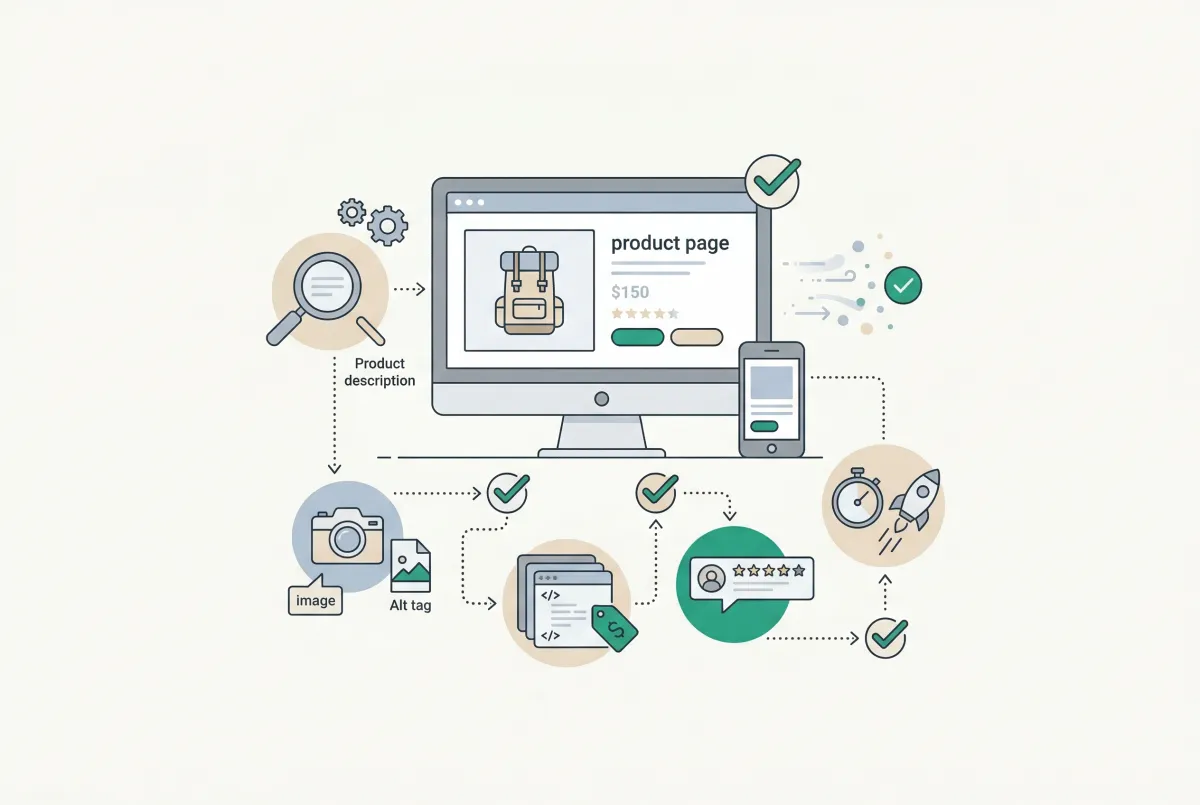
Most Shopify product pages are missing at least three core SEO elements. This 2026 checklist covers title tags, schema markup, images, and more.

Photo Reviews vs Text Reviews: Which Drive More Shopify Sales? (Data-Backed Answer)
Debating photo reviews vs text reviews for your Shopify store? Photo reviews convert up to 106% better, but not always. Here is the real data to decide.
Finding the best Shopify review apps? We compare Judge.me, Loox, Yotpo, Okendo, and Stamped on actual pricing, page speed, features, and hidden costs.

How to Use Customer Reviews in Your Shopify Marketing Strategy (Email, Ads, and Social Media)
Learn how to turn Shopify customer reviews into email campaigns, paid ads, and social media content that builds trust, improves conversions, and sells.

Learn how to import product reviews to Shopify from Amazon, AliExpress, Etsy, and more. Step-by-step guide with app recommendations and best practices.