
The Etsy vs Shopify choice is not a fee spreadsheet. It is a traffic problem wearing a pricing costume. Etsy rents you a marketplace that already has buyers. Shopify rents you a storefront and leaves demand as your job.
Handmade and craft sellers usually ask the wrong first question. They ask which platform is cheaper, then they close Etsy the week a Shopify theme goes live. That is how a shop that "won on fees" spends three months staring at an empty analytics graph.
This comparison is for sellers deciding whether to stay on Etsy, add Shopify beside it, or move. It is not a second listing-migration how-to. The move-the-catalog steps sit on a different URL, linked at the end, so this page can own the stay-versus-move call.
Etsy sells the marketplace. Shopify sells the brand. Most sellers who "lose on Etsy fees" still cannot replace Etsy traffic on day one of Shopify.
What is the real fee difference in Etsy vs Shopify?
Etsy charges you when you list and when you sell. Shopify charges a monthly plan, then a card rate on each paid order. The per-sale cut is lower on Shopify. The monthly bill is real even if you sell nothing.
For a US seller, Etsy's core stack in 2026 is a $0.20 listing fee (the listing lasts 4 months), a 6.5% transaction fee on the order total including shipping and gift wrap you charge, and Etsy Payments processing of 3% + $0.25 in the United States. Processing rates change by country. Do not copy the US rate if your payout bank is elsewhere.
Shopify's public pricing page lists Basic at $39 USD/month billed monthly or $29 USD/month billed yearly. Grow is $105/$79. Advanced is $399/$299. Plus starts at $2,300/month. Online standard card rates with Shopify Payments are 2.9% + 30¢ on Basic, 2.7% + 30¢ on Grow, and 2.5% + 30¢ on Advanced. Skip Shopify Payments and Basic adds a 2% third-party transaction fee on top of your gateway.
On a $20 US sale with free shipping, the line items look like this:
- Etsy: $0.20 listing + $1.30 transaction (6.5% of $20) + $0.85 processing (3% + $0.25) = $2.35, or 11.8% of the item.
- Shopify Basic with Shopify Payments: 2.9% of $20 + $0.30 = $0.88, or 4.4% of the item, plus the plan.
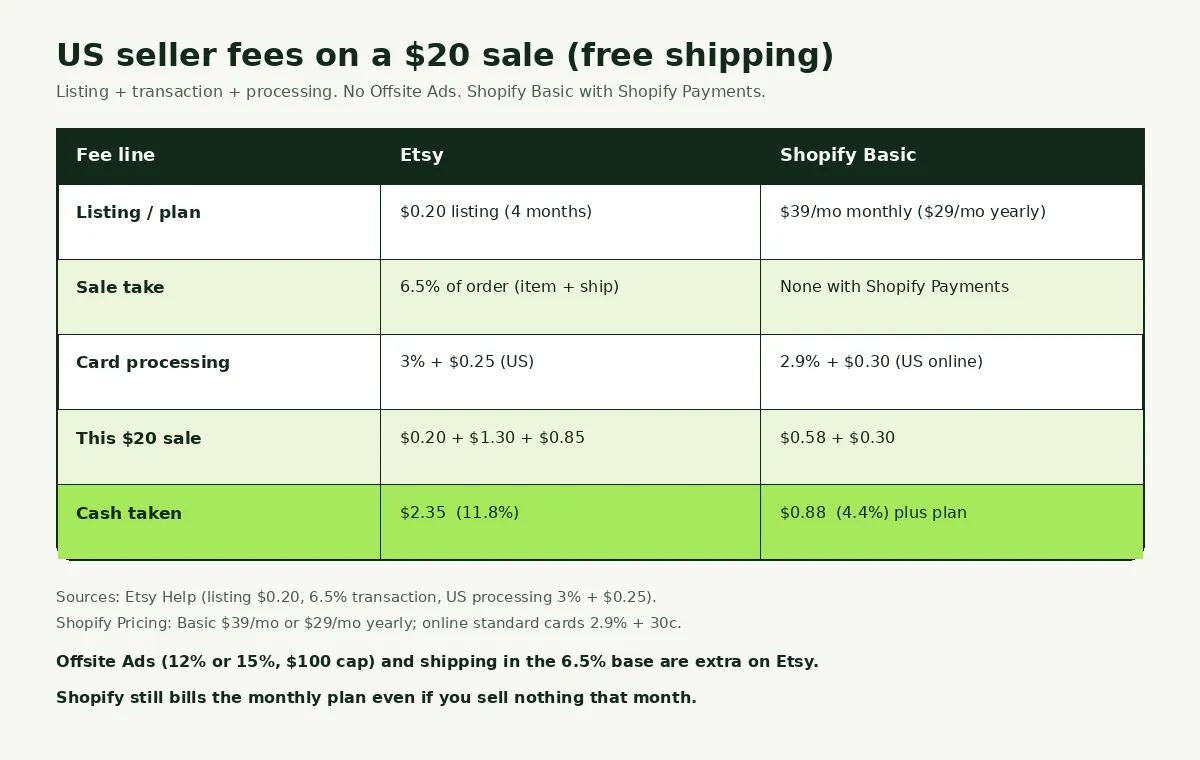
That $20 snapshot is honest and incomplete. It hides the monthly plan, Offsite Ads, and shipping inside Etsy's 6.5% base. Work the same math at volume, still assuming a $50 average order, free shipping, one listing fee per sale, and no Offsite Ads:
- $400/month, 8 orders: Etsy about $41.60. Shopify Basic monthly about $53. Etsy is cheaper if you sell little.
- $1,000/month, 20 orders: Etsy about $104. Shopify Basic monthly about $74. Shopify starts winning on cash taken.
- $5,000/month, 100 orders: Etsy about $520. Shopify Basic monthly about $214. The gap is hundreds of dollars a month before ads.
Yearly Shopify billing ($29/month on Basic) pulls that crossover down. At $400/month of sales the two stacks nearly tie. At $1,000/month yearly Basic is about $64 versus Etsy's $104.
Then Etsy adds advertising you do not fully control. Offsite Ads charge 15% on attributed orders if your shop has always stayed under $10,000 USD in any 365-day window, and 12% once you have crossed $10,000. The fee is capped at $100 per order. Under $10,000 you can opt out. Over $10,000, Etsy requires participation for the lifetime of the shop. That is the line that turns "Etsy is only 6.5%" into 6.5% plus a 12% or 15% ad fee on the orders those ads touch.
Charge $8 shipping on that same $20 item and Etsy's 6.5% applies to $28, not $20. Transaction becomes $1.82 and US processing becomes $1.09, so the sale costs about $3.11 before ads. Shopify Payments still prices the $28 charge at 2.9% + $0.30, or about $1.11, plus the plan. Shipping is not a free extra on Etsy. It sits in the fee base.
Shopify is not free either. Apps, a theme, a domain, and the ads you will need to replace Etsy search all sit outside the $39. The fee win is real at volume. It is not a traffic win.
Who actually sends you traffic?
Etsy sends shoppers who already came to buy handmade, vintage, and craft. Shopify sends nobody. Your ads, email, SEO, and social accounts send them, or they do not arrive.
Etsy's Q2 2026 shareholder letter put trailing-twelve-month active buyers at about 87 million, up roughly 350,000 sequentially and roughly stable year over year. Marketplace GMS was $2.6 billion in the quarter, up 7.5% year over year. Those buyers are searching Etsy, not your brand name.
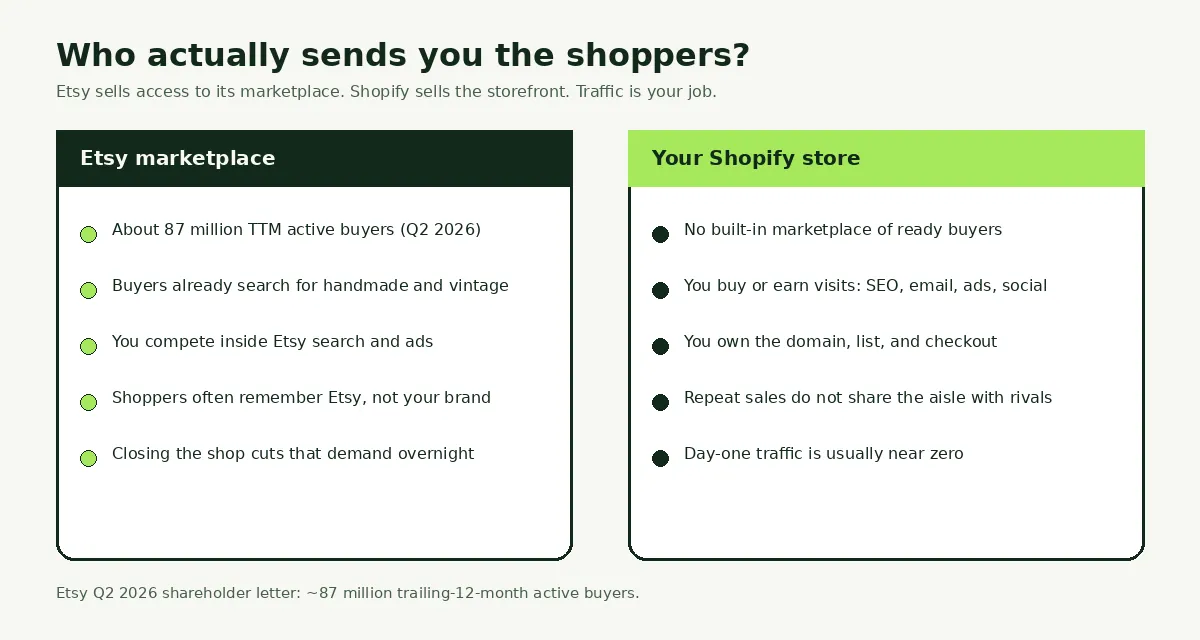
That is the part comparison posts skip when they celebrate Shopify's lower card rate. A new Shopify store has a custom domain, a theme, and an empty session count. Shopify merchants processed $115.6 billion of GMV in Q2 2026. That number is the platform's scale. It is not a pool of shoppers assigned to you.
Reviews work the same way. Etsy includes a native five-star system on the shop. Buyers have 100 days after delivery to leave a review, and the public score is a recency-weighted average, per Etsy's seller review help. Shopify's plan does not put that widget on your product page for you. Shop Product Reviews live inside the Shop app. On your own theme you still add a review app if you want stars on the PDP.
If reviews are part of why you are even comparing platforms, treat them as a vs factor, not a footnote. Etsy already hosts the social proof. Shopify makes you rebuild it. A tool such as WiseReviews can import existing Etsy reviews (Etsy is a named source in its docs) so the new store is not a wall of unrated products. The how-to lives in how to migrate product reviews from Etsy to Shopify without losing star ratings.
When should you stay on Etsy?
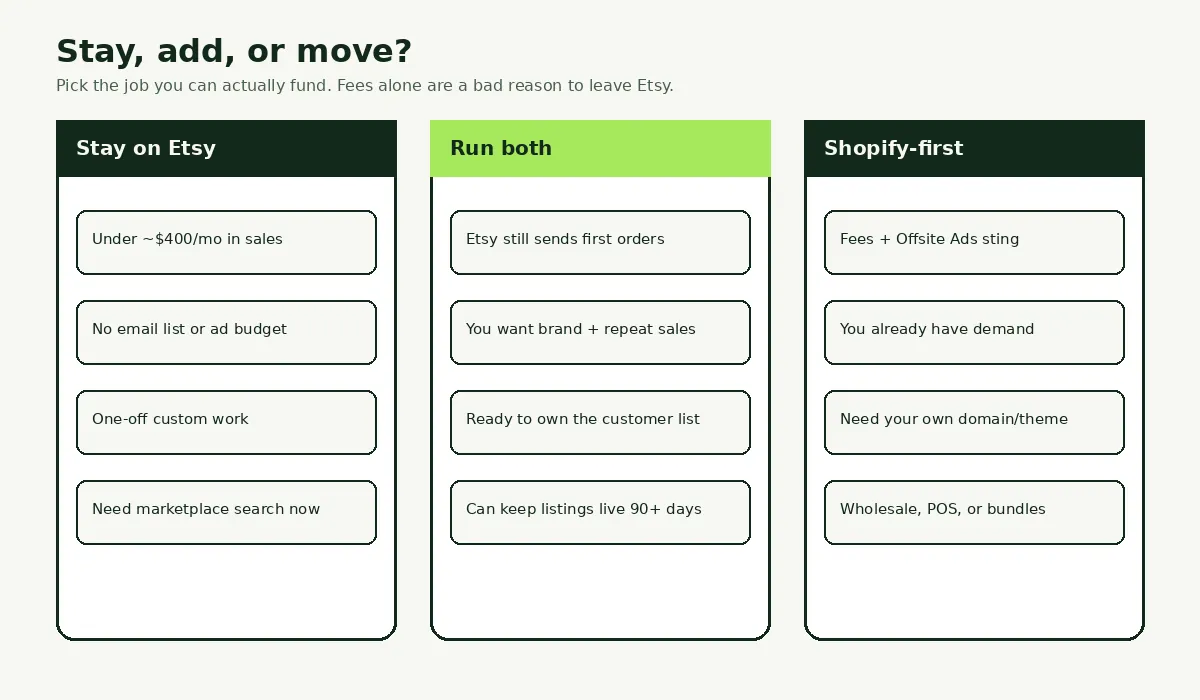
Stay on Etsy if marketplace search is still your only reliable customer source. If you cannot name the channel that will replace those sessions next month, do not close the shop to "save fees."
Stay, or stay as the primary channel, when most of these are true:
- Monthly sales sit under a few hundred dollars, where Etsy's pay-per-sale model still beats a $39 plan you cannot fill.
- You sell one-off custom work, made-to-order pieces, or vintage finds that match how Etsy buyers already search.
- You have no email list, no ad budget, and no content engine that can send a stranger to yourbrand.com.
- Your products need the handmade or vintage frame Etsy still markets. Shopify will not explain your craft for you.
- You are testing demand. A $0.20 listing is a cheaper experiment than a theme, apps, and three months of ads.
Fee pain is not the same as a demand engine. A jeweler doing $300 a month who "loses" $30 to Etsy still has orders. The same jeweler on Shopify with a prettier homepage and zero sessions has a cheaper processor and an unpaid studio week.
Stay also if your Etsy reviews, Star Seller status, and saved-shop followers are doing conversion work you have not rebuilt anywhere else. Those assets do not follow a domain change. You can export reviews later. You cannot export Etsy's search rank.
A practical test: write down last month's Etsy sessions you can actually see in Shop Manager, then write down every non-Etsy click you can name (email, your Instagram bio, Google brand search). If the second list is a handful of visits, you are not replacing the marketplace. You are hoping. Stay until that second list can pay rent for a slow month.
When does Shopify win?
Shopify wins when you already have demand you can point at a domain you control, or when Etsy's take, ads, and rules are capping a brand that is bigger than a marketplace stall. It wins on branding, customer data, and repeat purchase tools. It does not win on day-one discovery.
Move Shopify to the center of the business when several of these show up at once:
- You are past the fee crossover and Offsite Ads are mandatory, so a growing share of attributed orders pays 12% on top of 6.5% and processing.
- Customers already search your shop name, not a generic "handmade mug" query. Brand demand is wasted on a URL you do not own.
- You need a theme, bundles, wholesale, in-person POS, or subscriptions that Etsy's listing grid will not hold.
- You want to email buyers (with consent) instead of hoping they wander back through Etsy search.
- You are paying to send Instagram or Google traffic to Etsy, then watching Etsy suggest a neighbor's listing under yours.
Shopify also wins on the customer file. On Etsy, the relationship sits inside Etsy's checkout and message tools. On Shopify, that list is yours to segment, if you collected consent. If you do add a store, export your Etsy customer list to Shopify so the first welcome flow is not starting from zero.
Branding is the other Shopify win people feel before they can measure it. Your URL, your cart, your photography crop, your packaging insert, your post-purchase email: none of that has to look like the stall next door. Etsy will always put you in a grid with substitutes. That grid is useful when you need strangers. It is expensive when those strangers already wanted you.
None of that makes Shopify "best overall." Coming from WordPress commerce rather than a marketplace? Read the Shopify vs WooCommerce fees, features, and when-to-switch guide before you force a marketplace-style decision onto a self-hosted catalog. A $5,000/month ceramic shop with a Klaviyo list and a photographer is a different business from a weekend print-on-demand stall. The platform that fits the first will starve the second.
Can you run both?
Yes, and for most growing handmade shops that is the sane 2026 setup. Keep Etsy as the discovery aisle. Use Shopify as the brand, the repeat-purchase lane, and the place paid traffic should land.
Running both is not a hedge you set and forget. It is two inventories, two policies, two review systems, and two places a customer can leave a 3-star note. Do it on purpose:
- Keep Etsy listings live. Do not 301 what Etsy will not let you 301. Etsy listing URLs are Etsy's.
- Put the Shopify URL in the shop announcement and in listing descriptions, without turning every Etsy page into a spam redirect.
- Send email and ad traffic to Shopify, where you own the checkout and the list.
- Match SKUs so inventory does not double-sell. A sold-out ceramic on Shopify that is still live on Etsy is how you earn a bad review on the marketplace you still need.
- Keep Etsy shipping and review response times tight. Star ratings still close marketplace sales while the new domain warms up.
If you later wind Etsy down, Google traffic that hit listing pages will not magically hop to Shopify. There is no native Etsy-to-Shopify 301 for a listing. Plan the public-web side with how to redirect Etsy traffic to Shopify without losing SEO rankings before you deactivate anything.
Price both channels the same, or have a reason. A $48 mug on Etsy and a $42 mug on Shopify trains buyers to hunt the cheaper stall, and it trains Etsy to see you as a problem. Exclusive colorways or a small "own-site" bundle can live on Shopify without undercutting the listing that still feeds you strangers.
A dual-channel year is slower than a dramatic "we left Etsy" post. It is also how shops avoid lighting their only demand source on fire to shave two points of processing.
What if you do move from Etsy to Shopify?
Move the catalog, the customer emails you are allowed to use, and the reviews. Then keep Etsy open until Shopify sessions are not a rounding error. Do not treat go-live day as close-shop day.
This page will not walk the CSV column map. That job already has a URL. Follow how to move your Etsy products and keep your listings for export, field mapping, and the parallel-run window.
For the catalog itself, a URL importer is one option among several. Migratify copies product content from a public Etsy listing URL: title, description, images, variants, price, SKU, tags. Etsy imports cap at 100 variants. It does not move customers, orders, or reviews. Free is 5 products total, not 5 per month. Paid plans drop that cap. CSV and a full-service migrate tool still exist for shops that need more than products.
Reviews and customers stay separate jobs. Import stars with a review app after products exist, then attach emails. Closing Etsy before those two files are in Shopify is how sellers donate years of proof and a warm list to a blank theme.
If the move is real, budget time for the unglamorous parts: SKU hygiene, shipping profiles, tax, a review widget, and a 90-day overlap. Do not close Etsy on launch day. Do not spend a week rewriting every title for Google and then delete the only URLs that already rank. Do not import products and skip reviews. The shops that look cheaper on Shopify in month four are the ones that did not make month one their last month on Etsy.
Related Articles
How to Move from Etsy to Shopify in 2026: Products, Reviews, SEO
Move from Etsy to Shopify in 2026: export listings, fix variations, import with Store Migration or CSV, keep Etsy running, and rebuild reviews and SEO.
Shopify vs WooCommerce in 2026: Fees, Features, and When to Switch
Compare Shopify vs WooCommerce in 2026: real fees, hosting vs SaaS costs, checkout conversion, control, and when growing SMBs should switch platforms.

How to Redirect Etsy Traffic to Shopify Without Losing SEO Rankings
Moving off Etsy? Learn how to redirect Etsy traffic to Shopify without losing your SEO rankings using 301 redirects, backlink recovery, and smart timing.
How to Export Etsy Customers to Shopify in 2026 (What Etsy Lets You Keep)
Can you export Etsy customers to Shopify? Etsy withholds buyer emails, but order and shipping data can move. 2026 steps, plus legal ways to rebuild a list.
How to Migrate Product Reviews from Etsy to Shopify Without Losing Star Ratings
Star ratings vanish in most Etsy imports. Learn how to migrate product reviews from Etsy to Shopify with ratings, photos and rich snippets fully intact.
How to Migrate to Shopify: The Complete Step-by-Step Guide for Online Stores
Planning to migrate to Shopify? Avoid data loss, broken SEO rankings, and costly downtime with this complete step-by-step migration guide for merchants.