
Shopify Pricing Strategies: How to Price Products for Maximum Profit
Most Shopify store owners spend weeks perfecting their product photos, writing descriptions, and tweaking their storefront theme. Then they slap a price on their product based on gut feeling or whatever their competitor charges.
That's a problem. Your Shopify pricing strategies determine whether you build a profitable business or just a busy one, and a 1% improvement in pricing yields an average 11.1% increase in operating profit. No other lever in your business (not volume, not cost-cutting) comes close to that return.
Pricing isn't a one-time decision you make at product launch and forget. It's an ongoing process that requires understanding your true costs, your customer's perception of value, and the psychology behind why people buy. This guide walks you through the formulas, tactics, and testing methods that separate profitable Shopify merchants from those bleeding money without realizing it.
What Does It Actually Cost to Sell a Product on Shopify (Before You Set Any Price)?
Your true cost per sale is almost certainly higher than you think. Most merchants calculate cost of goods sold (COGS) and stop there, but COGS is just the starting line. You need to account for every dollar that leaves your account between sourcing a product and delivering it to a customer's door.
Here's a worked example. Say you sell a handmade candle with a $12 COGS. Your actual landed cost looks more like this:
- COGS: $12.00
- Shopify subscription (Basic plan, allocated per product): ~$0.50
- Payment processing (Shopify Payments at 2.9% + $0.30 on a $35 sale): $1.32
- Transaction fee (if using a third-party gateway): $0.70
- Shipping cost (average domestic): $5.50
- App subscriptions (spread across monthly sales): ~$1.00
- Return rate cost (if 10% of orders are returned, amortized): $1.20
- Customer acquisition cost (ad spend per sale): $4.00
That $12 candle actually costs you $26.22 to sell. If you priced it at $35 thinking you had a healthy $23 margin, your real margin is $8.78, or 25%. Still workable, but a far cry from the 66% margin you imagined.
The average net profit margin for Shopify merchants sits around 10%, with top performers reaching 20%. Branded direct-to-consumer stores that control their supply chain can hit 25-45% net margins, but they've earned those numbers through tight cost management and premium positioning.
If you're not calculating your full landed cost, you can't know where you actually stand.
Which Shopify Pricing Strategies Work Best for Your Store Type?
The right strategy depends on your product type, your brand positioning, and how defensible your value proposition is. There's no universal answer, but there are clear winners and losers for specific situations.
Cost-Plus Pricing
Add a fixed markup percentage to your landed cost. Simple, predictable, and safe. If your landed cost is $26.22 and you want a 50% margin, you'd price at $52.44 (round to $49.95 for psychological appeal).
This works well for commodity products where price shopping is common. The downside? Cost-plus ignores what your customer is willing to pay. You might be leaving 30% on the table because you never asked whether your audience values the product more than your spreadsheet suggests.
Value-Based Pricing
Price based on what customers believe the product is worth, not what it costs to make. A $15 t-shirt printed with an original design from a popular artist can sell for $45 because the perceived value has nothing to do with the cotton. Stores with strong social proof through product reviews can command higher prices because trust reduces purchase hesitation.
Value-based pricing requires you to deeply understand your audience. What problem does your product solve? How painful is that problem, and what alternatives exist? The answers determine your ceiling.
Competitive Pricing
Here's my honest take: competitive pricing is often the fastest route to thin margins and commoditization. Most Shopify pricing guides tell you to "research competitors and price accordingly," but if you're just matching or slightly undercutting the next store, you're in a race to the bottom.
Price low and you'll attract bargain hunters who leave the moment someone undercuts you by a dollar. The merchants winning on Shopify right now aren't the cheapest. They're the ones who've built enough trust and perceived value to charge what they're actually worth.
Competitive pricing only makes sense when you're selling identical products (like phone cases from the same supplier) and your only differentiator is price. For everyone else, invest in building a brand that justifies premium pricing.
Keystone Pricing
Double your wholesale cost. It's the retail industry's oldest rule of thumb, and it works as a starting point. Some products can support a 3x or 4x markup; others can't sustain 2x. Use it as a floor, not a ceiling.
How Do You Use Psychological Pricing to Increase Conversions Without Cutting Margins?
Psychological pricing works because humans don't process prices rationally. We respond to visual cues, anchoring effects, and mental shortcuts. These tactics let you maintain (or increase) your margins while making prices feel more attractive.
Left-Digit Anchoring (Charm Pricing)
Pricing a product at $29.99 instead of $30.00 isn't just a one-cent discount. A landmark study by Anderson and Simester published in Quantitative Marketing and Economics found that prices ending in 9 significantly increased sales in controlled catalog experiments. Across broader research, charm pricing has been shown to increase sales by an average of 24% compared to rounded price points.
The reason is the left-digit effect: our brains anchor on the "2" in $29.99 rather than processing the full number. That one-cent difference makes the price feel like it belongs in the twenties, not the thirties.
Use charm pricing on your mid-range products where customers are price-comparing. For luxury or artisan goods, rounded numbers ($50, $100) actually perform better because they signal quality and simplicity.
The Decoy Effect (Three-Tier Pricing)
Offer three options: a basic version, a premium version, and a mid-tier option that's clearly the best deal. The basic option exists to make the mid-tier look valuable. The premium option exists to make the mid-tier look reasonable. Most customers pick the middle.
For example, a skincare brand might offer a single serum for $35, a two-pack for $55, and a three-pack with a bonus sample for $70. The two-pack becomes the obvious choice, and your AOV just jumped from $35 to $55.
Compare-at-Price Anchoring
Shopify has a built-in "Compare at Price" field on every product. When you fill it in, your theme displays the original price with a strikethrough next to the sale price. A product listed at $49.95 with a compare-at price of $79.95 feels like a steal, even if $49.95 was always the intended price.
Use this honestly. Set your compare-at price to a legitimate reference point (your MSRP, the price competitors charge, or your own previous price during non-sale periods). Fake anchoring erodes trust fast, and savvy shoppers will check your price history using browser extensions.
How Can Bundle and Tiered Pricing Lift Your Average Order Value?
Bundling is one of the highest-impact pricing tactics available to Shopify merchants. Well-designed bundles can produce AOV increases of 20-55%, depending on execution. The key is designing bundles that make logical sense to the customer, not just cramming unrelated products together.
Pure Bundles vs. Mixed Bundles
A pure bundle sells products only as a set (like a complete skincare routine). A mixed bundle offers the set at a discount while still letting customers buy items individually. Mixed bundles almost always outperform pure bundles because they give customers perceived freedom of choice while nudging them toward the higher-value option.
Tiered Volume Discounts
Consider a simple tiered structure: one unit for $25, three for $60, five for $85. Volume tiers work exceptionally well for consumable products like supplements, coffee, or pet food where customers will use up the product anyway. You're not discounting your way to lower margins. You're capturing revenue that would have gone to a competitor next month.
The math has to work, though. Run the numbers on your landed cost at each tier. A customer buying 5 units at $17 each might be more profitable than one buying a single unit at $25, because your per-unit shipping and acquisition costs drop significantly on larger orders.
Add-On and Upsell Pricing
Price your primary product competitively, then offer custom product options and add-ons with healthy margins. A $40 cutting board with an optional $12 engraving (that costs you $2 to add) is a classic example. The base product gets the customer in the door, and the add-on is where the margin lives.
This strategy maps directly to how customers make decisions. They've already committed to the main purchase; a small add-on feels incremental even if its margin percentage is triple that of the core product.
How Do You Test and Adjust Prices Without Risking Your Whole Catalog?
Price testing is where most Shopify merchants freeze up. The fear of alienating customers or tanking conversions keeps them stuck at the same prices for years. But not testing prices is itself a decision, and probably a costly one.
Dynamic pricing strategies boost profits 5-8% on average and can produce 5-15% conversion rate increases post-implementation.
Start Small with A/B Price Testing
Pick 5-10 products that get consistent traffic. Test a 10-15% price increase on half of them for two weeks. Measure conversion rate, revenue per visitor, and profit per visitor (not just sales volume).
A price increase that drops conversions by 5% but increases revenue per visitor by 20% is a win. Use Shopify's built-in analytics to track these metrics, and compare the test period against the same time frame from the previous month to account for seasonal patterns. Don't test during holidays or major promotions; the noise will drown your signal.
The Operational Reality of Bulk Price Changes
Changing prices on 5 products is easy. Changing prices on 500 SKUs, validating every change, and rolling it back when something goes wrong? That's a different challenge entirely. Shopify's native bulk editor handles basic changes, but it doesn't offer preview, scheduling, or undo.
For serious price testing across a large catalog, you need a tool that lets you preview changes before they go live, schedule price updates (especially for seasonal campaigns like BFCM), and revert with one click if a test doesn't work. Edify handles exactly this: you can bulk edit prices across your entire catalog with preview and scheduling, then undo all changes instantly if the results disappoint. That safety net is what makes aggressive price testing possible instead of terrifying.
Seasonal and Time-Based Repricing
Your prices shouldn't stay flat all year. Demand fluctuates, and your pricing should reflect that. Raise prices 10-15% during peak demand periods (Black Friday prep season in September-October, holiday gifting in November-December) and test lower prices during slow months to maintain volume.
The trick is automating this. Manually updating hundreds of prices before BFCM and reverting them after is a recipe for errors and missed deadlines. Schedule your price changes in advance, set revert dates, and let the system handle the transitions. Your holiday pricing strategy should be locked in well before the rush starts.
What Are the Most Common Shopify Pricing Mistakes That Quietly Kill Profit?
These mistakes are silent. They don't trigger error messages or crash your store. They just slowly drain your profitability while you wonder why revenue keeps growing but your bank account doesn't.
Mistake 1: Benchmarking Against Amazon or AliExpress
New Shopify merchants frequently look at Amazon or AliExpress prices and try to match them. Amazon sellers operate on razor-thin margins because Amazon drives the traffic. AliExpress prices don't account for shipping times, quality expectations, or customer service.
Your Shopify store has customer acquisition costs, payment processing fees, app subscriptions, and return handling that those prices don't reflect. If a product sells for $15 on AliExpress and you're paying $8 in COGS plus $4 in customer acquisition, your true cost is already $12 before Shopify fees, shipping, and returns. Selling at $15 means you're paying customers to buy from you.
Mistake 2: Free Shipping That Isn't Free
Offering free shipping without building the cost into your product price is just a hidden discount. Forty percent of consumers switch retailers to find better prices, and 48% abandon checkout due to unexpected shipping costs.
So yes, you probably need to offer free shipping. But build it into the product price. A $45 product with free shipping will outsell a $38 product with $7 shipping nearly every time, because the total is identical but the perception is radically different.
Mistake 3: Never Raising Prices
Costs go up. Supplier prices increase, shipping rates climb, and Shopify adjusts its fees. If you haven't raised your prices in over a year, your margins have almost certainly shrunk.
Most customers won't notice a 5-8% price increase, especially if your product quality and experience remain strong. The ones who leave over a dollar were never loyal customers anyway.
Mistake 4: Discounting as a Default Strategy
Running a sale every month trains your customers to never pay full price. They'll wait for the next discount, bookmark your store, and only buy during promotions. Your "regular" price becomes meaningless.
Instead, use discounts strategically: seasonal sales, cart abandonment recovery, and loyalty rewards for repeat customers. Make full-price purchases the norm, not the exception.
Mistake 5: Ignoring Profit Per Visitor
Most merchants obsess over conversion rate, but conversion rate alone is misleading. A store converting at 4% with $20 average profit per order makes $0.80 per visitor. Meanwhile, a store converting at 2.5% with $45 average profit per order makes $1.13 per visitor. The "worse" conversion rate is actually 41% more profitable.
Tracking this metric will change how you think about pricing entirely. A price increase that drops your conversion rate by half a percentage point but lifts your profit per visitor by 15% is an obvious win that most merchants would never discover because they only watch the conversion dashboard.
Pricing is the single most powerful lever in your Shopify business, yet most merchants treat it as a set-and-forget decision. Calculate your true landed costs, pick a strategy that matches your brand positioning, use psychological pricing to convert without discounting, test changes methodically, and avoid the common traps that silently erode your margins. Do this consistently and you won't just grow revenue. You'll actually keep the profit.
Related Articles
How to Run a Shopify Sale Without Destroying Your Margins
Learn how to run a Shopify sale that drives revenue without crushing profit margins. Strategy, math, and tools every store owner needs before discounting.
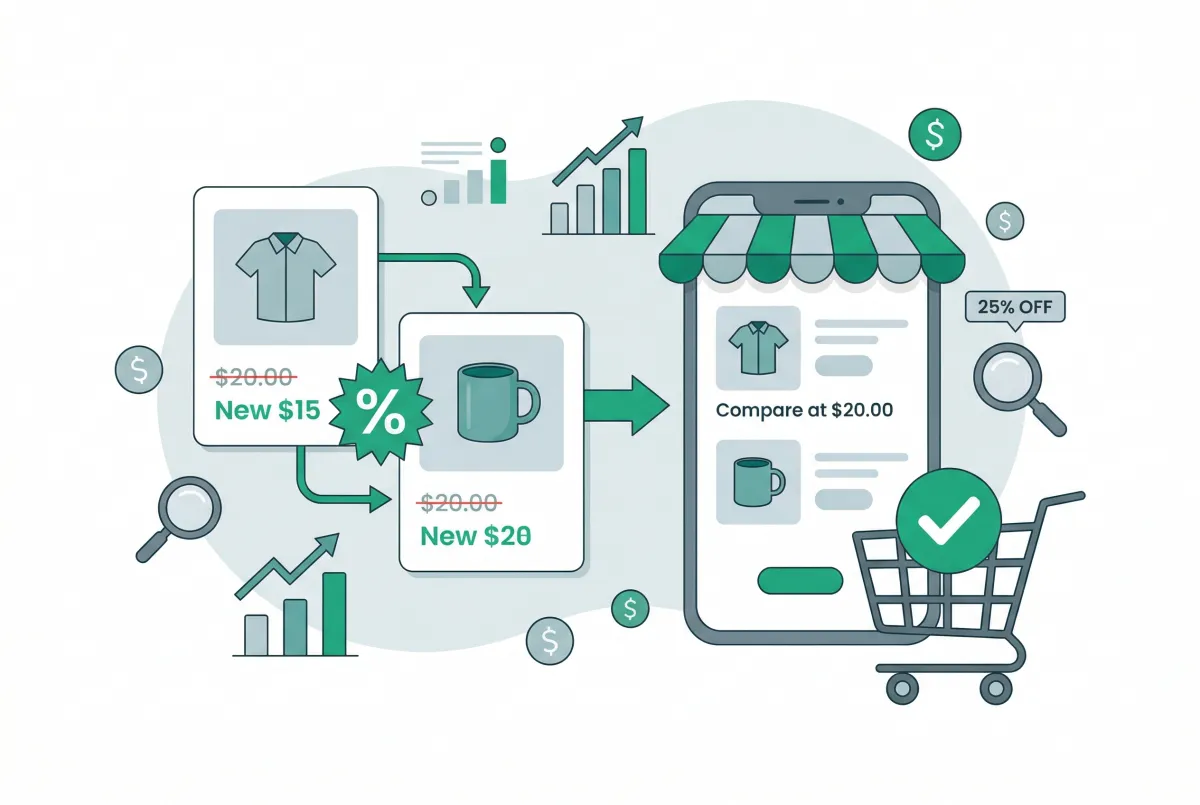
Compare-at Pricing on Shopify: How to Show Discounts That Actually Convert
Learn how compare-at pricing on Shopify works, how to set it up correctly, and the strategies that turn strikethrough pricing into real conversions.
How to Schedule Bulk Price Changes on Shopify (3 Methods That Actually Work)
Three methods to schedule bulk price changes on Shopify: native bulk editor, CSV import, and dedicated apps. Stop updating prices one by one at midnight.
Shopify Bulk Product Editing: The Complete Guide to Updating Your Catalog Fast
Master Shopify bulk product editing with the native editor, CSV imports, and third-party apps. Update prices, tags, and descriptions across your catalog fast.
Best Shopify Bulk Product Editor Apps Compared (2026)
Compare Shopify bulk product editor apps by undo depth, backup windows, 2026 pricing, scheduling, and catalog size so you pick a safe fit for your store.
Learn to write Shopify product descriptions that rank on Google and convert shoppers into buyers. Includes SEO tips, copywriting frameworks, and examples.